Picky Eating in Children: A Chinese Medicine Guide for Tired Spleens
8 min read · Eastern body wisdom for families
Quick Answer
If mealtime has become a daily negotiation, your child's Spleen is probably as exhausted as your patience. In Chinese medicine, picky eating is rarely character or discipline. It is almost always a Spleen that has learned to shut down. The pattern usually combines Spleen Qi Deficiency with Liver Qi Stagnation. The Spleen is tired from being overfed, under-chewed, or pushed past full. The Liver is tight from mealtime stress, screen conflicts, or rushing. Together they create a child who would rather not eat than risk another battle. Light appetite-stimulating foods such as hawthorn tea, tangerine peel water, fennel, and small warm bowls of millet porridge may gently reopen the Spleen over one to two weeks.
How Chinese Medicine Sees Picky Eating
Conventional advice on picky eating usually falls into one of two camps. Either it is a behavior problem that needs firmer limits, or it is a phase that should be ignored until they grow out of it. Chinese medicine offers a third view: picky eating is information. It is the Spleen saying it cannot handle more right now.
Two organ pairs are almost always involved. The Spleen is the digestive core, the part that turns food into usable energy. In young children it is naturally immature, which is covered in detail in our guide to Chinese medicine for child digestion. The Liver, in TCM theory, is responsible for the smooth flow of energy and emotions. When a child is tense, pressured, scolded, or overstimulated at meals, Liver Qi tightens. A tight Liver directly weakens the Spleen. The result is a child who is genuinely not hungry, even when they ate poorly at the last meal.
This explains why rewards, punishments, and bribery tend to backfire. They add emotional pressure. More pressure tightens the Liver. A tighter Liver further weakens the Spleen. The Spleen shuts down harder. The child eats less, the parent pushes more, and the loop tightens. Breaking the loop requires addressing both the Spleen and the Liver, not just the behavior at the table.
Curious which body type you are? Take the free 5-minute quiz.
Take the Free Quiz →Picky Eating Patterns in Children
Picky eating shows up in slightly different forms. The pattern tells you where to focus.
| Pattern | Key Signs | Mechanism | Food Direction |
|---|---|---|---|
| Spleen Qi Deficiency | Eats only 3 or 4 foods, low appetite, tired after eating | Spleen cannot generate enough energy to handle variety | Warm, soft, easy foods in small portions |
| Liver Qi Stagnation | Sensitive to pressure, picky plus irritable, holds food in mouth | Emotional tightness has blocked smooth digestion | Aromatic relaxants: tangerine peel, fennel, mint |
| Spleen with Damp | Heavy, lethargic, refuses oily or rich foods, sticky mouth feel | Dampness has accumulated and is dulling the Spleen | Gently drying foods: millet, radish, job's tears |
| Stomach Heat | Hungry but picky, prefers cold drinks, bad breath, restless | Heat in the Stomach is spoiling appetite | Cooling gentle foods: pear, lotus root, mung bean |
What Causes Picky Eating in Children
Most picky eating is not a single cause. It is a stack of small patterns that gradually train the Spleen to close.
A history of force-feeding
If a child has been pressured to finish plates, eat on a parent's timeline, or eat when not hungry, the Spleen learns to defend itself by shutting down. The result is a child who appears willful but is actually protecting an overworked system. Undoing this takes time and consistent non-pressure.
Too many intense flavors early
Sugar, salt, and processed flavors train a child's palate to expect high intensity. Mild, warm, plain foods like congee or steamed vegetables stop registering as food. The Spleen, asked to handle flavors stronger than it can process, refuses the mild foods it actually needs.
Sensory defensiveness, especially texture
Some children are genuinely more sensitive to textures, smells, and mixed foods. In TCM terms this often reads as a Liver that is overly reactive. The fix is not exposure therapy with pressure. It is gentle, gradual exposure without emotional charge, paired with foods that calm the Liver.
Stressful or screen-filled meals
Arguing, scolding, or eating while watching something all pull attention away from digestion. The Spleen cannot do its job without attention. Children who eat in front of tablets often stop eating mid-bite and do not notice. They are not misbehaving. Their nervous system has deprioritized digestion.
The snack cycle, never truly hungry
Grazing all day means the Spleen never has a clear stretch to rest and rebuild appetite. By real mealtime, the child is not hungry enough to want real food. They pick, get offered a snack an hour later, and the cycle continues. The Spleen learns to expect a steady trickle of easy calories, never a real meal.
Foods That May Gently Reopen a Child's Appetite
These foods are aromatic, warm, and traditionally used to wake up a tired Spleen. They are not magic. They work best when combined with the habit changes below, especially removing pressure from mealtimes.
| Food | TCM Property | How It May Help | How to Prepare |
|---|---|---|---|
| Hawthorn (Shan Zha) | Warm, sour, sweet | The classic TCM appetite stimulant; traditionally used when a child has eaten poorly for days | Steep 2-3 dried slices in hot water with a little rock sugar |
| Tangerine peel (Chen Pi) | Warm, aromatic, bitter | Moves Liver Qi, gently warms the Spleen; eases the tension that shuts appetite down | Steep a small piece in hot water, 5 minutes |
| Fennel seed | Warm, aromatic, sweet | Relaxes the digestive middle, gently aromatic for children | Tiny pinch steeped in warm water, or in soup |
| Malt (Mai Ya) | Warm, sweet | Traditionally used to help the Spleen break down starches; mild and child-friendly | Simmer in porridge or as a light tea |
| Radish, cooked | Neutral, slightly warm | Gently moves Qi, eases the heavy feeling that kills appetite | In soup or stir-fry, soft and well-cooked |
| Millet porridge | Warm, sweet | The grain that asks the least of a tired Spleen; a gentle base for any appetite-rebuilding routine | Cook 1 part millet to 6 parts water, soft |
| Papaya | Neutral, sweet | Contains natural enzymes; in TCM terms, gently supports Spleen function | Fresh, ripe, in small amounts |
| Mint, very small amount | Cool, aromatic | Diffuses Liver Qi stagnation; useful when irritability accompanies picky eating | Single leaf in warm water, not daily |
| Sweet rice (glutinous rice) | Warm, sweet | Warms and gently tonifies Spleen; small amounts mixed into regular rice | Replace 1/4 of rice with sweet rice in porridge |
Foods to Pull Back On During a Picky Phase
These foods are not banned. They are simply the ones most likely to train the palate away from real meals. Most families see a noticeable shift within two weeks of pulling them back.
- –Sugary snacks, especially between meals, which kill appetite for real food
- –Salty processed snacks like chips and crackers that overstimulate the palate
- –Cow's milk right before meals, which fills small stomachs with low-variety calories
- –Fruit juice and sweet drinks, which the body reads as food without the substance
- –Heavy fried foods, which overwhelm a tired Spleen and suppress the next meal
- –Cold drinks at the table, which slow Spleen function right when it is needed
Daily Habits That Rebuild Appetite
These habits address the Liver side of the loop as much as the Spleen. Most parents see real change within two weeks of consistent practice.
- 1.Set clear meal and snack times, with nothing in between except water. Three meals and one or two planned snacks, no grazing. The Spleen rebuilds appetite when it actually gets hungry between meals.
- 2.The one-bite rule, not the clean-plate rule. One bite of each food, no pressure to finish. Removing pressure is one of the fastest ways to relax the Liver and reopen appetite.
- 3.Eat together, without screens. Even ten minutes of shared attention shifts the meal. Digestion requires attention. So does a relaxed nervous system.
- 4.Do not praise eating or punish not eating. Both turn food into a performance. The goal is a child who eats because they are hungry, not because the parent is happy.
- 5.Involve them in cooking, even in tiny ways. Stirring, washing, choosing between two vegetables. Children who touch food before mealtime are far more likely to try it at mealtime.
- 6.Get 20 to 30 minutes of outdoor play before meals. Movement moves Liver Qi. A child who has been sitting all day often has no appetite at dinner, even if their stomach is technically empty.
- 7.Serve one familiar alongside one new, no pressure. The familiar food is the safety. The new food is the exposure. Over weeks, repeated low-pressure exposure works far better than any single push.
A Family Routine: Hawthorn and Tangerine Peel Tea
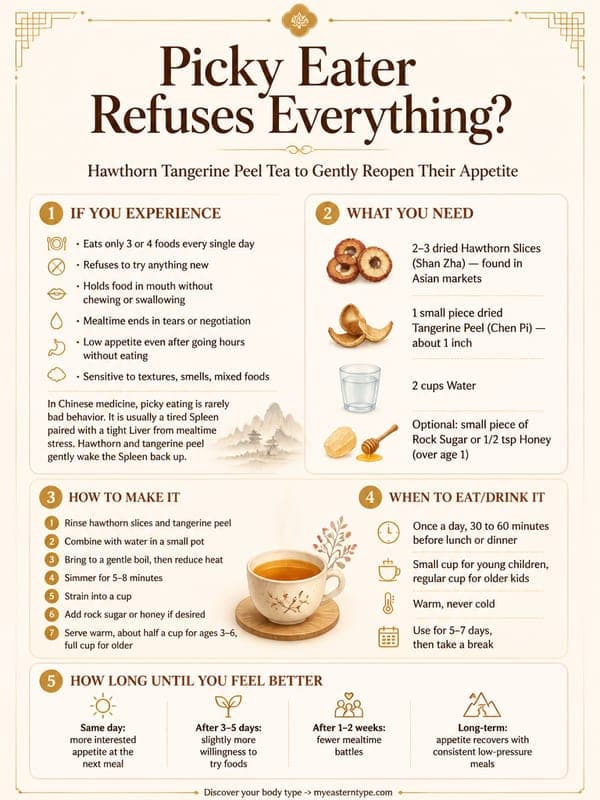
This is the tea Chinese families reach for when a child has been eating poorly for several days. It is mildly sour, gently sweet, and aromatic in a way that quietly signals the Spleen to wake up. Give it 30 to 60 minutes before a meal.
What you need
- 2 to 3 dried hawthorn slices (Shan Zha)
- 1 small piece dried tangerine peel (Chen Pi), about 1 inch
- 2 cups water
- Optional: a small piece of rock sugar or 1/2 teaspoon honey (over age 1)
How to make it
- 1. Rinse the hawthorn slices and tangerine peel.
- 2. Combine with water in a small pot.
- 3. Bring to a gentle boil, then reduce heat.
- 4. Simmer 5 to 8 minutes.
- 5. Strain into a cup. Add a small piece of rock sugar or honey if desired.
- 6. Serve warm, about half a cup for ages 3-6, full cup for older children.
When and how much
- Once a day, 30 to 60 minutes before lunch or dinner
- Small cup for young children, regular cup for older kids
- Warm, never cold
- Use for 5 to 7 days, then take a break. Daily use for long periods is not recommended.
What to expect
- Often a more interested appetite at the next meal
- Over 3 to 5 days, slightly more willingness to try foods
- Over 1 to 2 weeks of consistent habit changes, fewer mealtime battles
- Long-term: appetite recovers when pressure is removed and rhythm is restored
Don't Lose This Recipe
Pin this to your family wellness board so it's one tap away when your child needs it. Over 2,000 parents have saved these recipes already. Then take our free 5-minute body type quiz to learn which constitution runs in your family.
When to See a Doctor
Picky eating in young children is common and usually improves with consistency and time. Talk to your pediatrician if any of the following are present:
- Weight loss or dropping off their growth curve
- Eating fewer than 5 to 10 foods total for an extended period
- Difficulty swallowing, gagging, or vomiting with certain textures
- Signs of food allergy or intolerance (rash, hives, vomiting, diarrhea)
- Extreme distress around food that affects daily life
- Lack of hunger even after going many hours without eating
Curious which body type you are? Take the free 5-minute quiz.
Take the Free Quiz →Frequently Asked Questions
Should I force my child to finish their plate?+
Is picky eating always a Spleen problem in Chinese medicine?+
How do I introduce hawthorn tea to a toddler?+
How long does it take to reverse a picky eating pattern?+
Which body type is most linked to picky eating in children?+
Related Reading for Families
Picky eating is almost always rooted in weak Spleen function. This page covers the developmental theory and the warm, soft foods that build the Spleen back up.
Chinese Medicine for Child ConstipationPicky eating and withholding stools often go together. When one improves, the other usually follows.
Liver Qi Stagnation: Why Stress Slows EverythingThe adult version of the same Liver pattern that drives mealtime stress in children. Useful for parents who recognize the loop in themselves.
The Qi Deficient Body TypeMany picky children have a Qi Deficient parent. Understanding your own constitution can explain family patterns.
Discover Your Eastern Type
Take our free 5-minute assessment to explore which body type best matches your current wellness patterns.
Take the Free Quiz→