Chinese Medicine for Child Digestion: Spleen-Supporting Foods That May Help
9 min read · Eastern body wisdom for families
Quick Answer
In Chinese medicine, a child's Spleen, the organ pair that turns food into usable energy, is considered naturally immature until about age 6 or 7. That immaturity is a developmental stage, not a defect. Two patterns often show up in children with weak digestion. Spleen Qi Deficiency looks like small appetite, loose stools with undigested bits, and tiredness after meals. Spleen Yang Deficiency adds cold hands, pale face, and a tendency to feel chilly. Warm, easy-to-digest foods such as rice congee with Chinese yam, jujube dates, and gently cooked root vegetables may help the Spleen gradually strengthen over several weeks.
How Chinese Medicine Sees a Child's Digestion
Classical Chinese pediatric texts describe children with a memorable phrase: liver is excessive, spleen is insufficient. The Spleen, in TCM theory, is the functional system responsible for transforming food into Qi and Blood. It is not the same as the anatomical spleen in Western medicine. It is more of a digestive and absorptive system that also shapes how energy is distributed through the body.
The insufficient Spleen idea has practical consequences. Young children are not small adults. Their digestive capacity is genuinely smaller relative to what they need. They are growing rapidly, which means they need a lot of fuel, but their ability to process that fuel is still maturing. That mismatch, high demand with low capacity, is what makes young children so vulnerable to tummy trouble, picky phases, and slow recovery after illness.
A common traditional practice in Chinese households reflects this. For the first 100 days after introducing solid foods, families often lean on rice congee, soft, slow-cooked, almost pre-digested rice porridge. It is not because they lack other options. It is because congee asks very little of an immature Spleen while giving it a lot to work with. Around ages 6 to 7, the Spleen is said to be more settled. Digestion becomes more forgiving. This tracks loosely with what many parents observe: the picky toddler who eats three things becomes a 7-year-old who will try mostly anything. The picky phase was a real phase, and underneath it was a Spleen slowly growing into itself.
Curious which body type you are? Take the free 5-minute quiz.
Take the Free Quiz →Child Digestion Patterns in TCM
Weak digestion in children is rarely one thing. It usually shows up as one of four patterns, sometimes in combination. Identifying the closest match helps with food choices.
| Pattern | Key Signs | Mechanism | Food Direction |
|---|---|---|---|
| Spleen Qi Deficiency | Small appetite, tired after eating, loose stools | Cannot transform food into usable energy efficiently | Warm, soft, well-cooked foods in small portions |
| Spleen Yang Deficiency | Same as Qi, plus cold hands, pale face, loves warmth | Spleen lacks the fire to break food down | Warming foods, small amounts of ginger and cinnamon |
| Stomach Yin Deficiency | Dry stools, picks at dry foods, dry mouth | Stomach lacks the moisture to process food smoothly | Lightly moistening foods like pear, lotus seed, millet |
| Damp-Cold in the Middle | Bloated, sticky loose stools, low appetite | Cold has settled in the digestive middle, slowing everything | Warming aromatics like fennel and tangerine peel |
What Causes Weak Digestion in Children
Most cases of weak digestion in children are not from any one thing. They are the result of small daily mismatches between what a child's Spleen can handle and what they are actually eating. Five patterns show up over and over.
Too many cold and raw foods
In TCM theory, cold food requires the body to spend warmth digesting it. For an adult with a mature Spleen, that is no problem. For a 4-year-old whose Spleen is still developing, an ice-cold smoothie or raw salad pulls warmth away from where it is needed. The Spleen has to work overtime, and over time, it tires.
Irregular meal times
The Spleen, like most systems, likes rhythm. A child who eats at 7 AM one day and 10 AM the next is asking their digestive system to be ready at any moment. Children do well with predictable meal and snack times. Even a 30-minute difference, made consistently, can shift things.
Overeating and forced eating
The clean-your-plate approach is tough on a child's Spleen. The Spleen has a daily capacity. When a child is forced to eat past full, the extra food does not become extra energy. It becomes what TCM calls dampness, a heavy, sticky byproduct that further slows digestion. Picky eating is often the Spleen protecting itself.
Recovery from illness or antibiotics
After a stomach bug, a round of antibiotics, or even a long viral illness, a child's digestion is often stretched thin. Appetite drops, stools get weird, and parents worry. TCM views this as the Spleen rebuilding. Going straight back to a normal diet is often too much. The traditional approach is to start with congee, broth, and easily absorbed foods for a few days before reintroducing heavier meals.
Emotional stress at the table
The Spleen and the Liver are paired in TCM theory. When a child is anxious, scolded, or rushing through meals, the Liver Qi tightens and the Spleen cannot do its job. Mealtimes that involve arguing, screens, or pressure often produce children who genuinely feel sick afterward, and they are not faking.
Foods That May Help Strengthen a Child's Spleen
These foods are drawn from traditional Chinese dietary practice for children. They are gentle, warming, and easy to digest. None are exotic; most are everyday staples in many kitchens. Use them as a starting point and adjust based on what your child actually enjoys.
| Food | TCM Property | How It May Help | How to Prepare |
|---|---|---|---|
| White rice (jasmine or short grain) | Neutral, sweet | The most easily digested grain for an immature Spleen; the base of congee | Cook with extra water into soft porridge |
| Chinese yam (Shan Yao) | Neutral, sweet | Mildly supports Spleen Qi; traditionally used for children's digestion and energy | Peel and slice into congee or soup |
| Jujube (red dates) | Warm, sweet | Mildly supports Spleen and Blood; natural sweetness children like | Pit and add 2-3 to congee or tea |
| Millet | Warm, sweet | Considered the most digestible grain after rice; gentle on a tired Spleen | Cook as porridge with jujube |
| Pumpkin | Warm, sweet | Soft, sweet, easy to digest; supports the Spleen and gently drains damp | Steam or roast, mash into porridge |
| Lotus seed | Neutral, sweet | Calms digestion and supports the Spleen; traditionally used for loose stools | Soak, cook into congee |
| Carrot | Neutral, sweet | Gentle Spleen support; soft when cooked; easy for children to accept | Steam, mash, or cook into soup |
| Sweet potato | Neutral, sweet | Warming with steady energy; richer than rice, so use smaller amounts | Roast or steam, mash |
| Chicken or vegetable broth | Warm | Easy to absorb; carries warmth directly to the middle; a recovery staple | Slow-simmer with ginger, salt only at the end |
Foods to Limit When Digestion Is Weak
These foods are not bad. They are simply harder for an immature Spleen to handle. Limiting them temporarily, while a child's digestion rebuilds, can make a real difference.
- –Ice water and very cold drinks, which force the body to warm them up before processing
- –Excessive raw fruit, especially cold-natured ones like banana and citrus, in large daily amounts
- –Dairy in excess, since milk, cheese, and ice cream are considered damp-forming in TCM and further slow a weak Spleen
- –Deep-fried foods, which are heavy and heat-forming, a difficult combination for children
- –Concentrated sweets, which create temporary heat that leaves the Spleen more depleted
- –Very spicy or strongly seasoned dishes that overstimulate the Stomach in ways children are not ready for
Daily Habits That Support Digestion
These are the small, repeatable habits that traditional Chinese pediatric advice comes back to. None of them require special ingredients.
- 1.Warm breakfast within an hour of waking. The Spleen is most receptive in the morning. A bowl of warm congee or oatmeal signals the system to start digesting.
- 2.Small portions, more often if needed. A tired Spleen handles half a bowl better than a full one. Five small meals often work better than three big ones for young children.
- 3.Chew thoroughly. Twenty chews per bite is the traditional guidance. Digestion starts in the mouth, and rushed eating forces the Spleen to work harder.
- 4.No screens at the table. Digestion requires attention. Screens pull attention away, and digestion slows.
- 5.Light movement after meals. A 5 to 10 minute walk after eating helps the Spleen move food through. Lying down right after meals is one of the worst habits.
- 6.Keep ice out of drinks. Room temperature or warm water is the default. Cold drinks at meals are especially disruptive.
- 7.Largest meal at lunch, lighter dinner. Digestion is strongest at midday. A heavy dinner forces the Spleen to work all night, often disrupting sleep.
A Family Routine: The Morning Congee
This is the routine behind the congee recipe that gets shared widely with parents. It is simple, takes about an hour of mostly hands-off time, and uses four core ingredients. It is one of the most reliable ways to start rebuilding a child's Spleen.
What you need
- 1/2 cup white rice, jasmine or short grain
- 5 cups water
- 3 slices fresh Chinese yam (or 2 tablespoons dried)
- 2 red dates (jujube), pitted
- Tiny pinch of salt at the end
How to make it
- 1. Rinse the rice until the water runs clear.
- 2. If using fresh Chinese yam, peel and slice into thin rounds.
- 3. Combine rice, water, Chinese yam, and red dates in a pot.
- 4. Bring to a boil, then reduce to very low heat.
- 5. Simmer 45 to 60 minutes, stirring occasionally so the rice does not stick.
- 6. The congee is ready when it looks like a smooth, thick porridge.
- 7. Skim out the red date skins if your child prefers. Add a tiny pinch of salt.
- 8. Serve warm, in small portions.
When and how much
- Breakfast, or one meal replacement per day for the first week
- Half a bowl for young children (ages 2-5), full bowl for older kids (6+)
- Always warm, never cold
- Continue daily for 1 week, then 2-3 times per week as maintenance
What to expect
- First 3-5 days: usually better appetite, fewer complaints of stomach pain
- After 1 week: stools typically more formed and regular
- After 2-3 weeks: steadier energy, fewer picky eating battles
- Long-term: continue 2-3 times per week as a maintenance habit
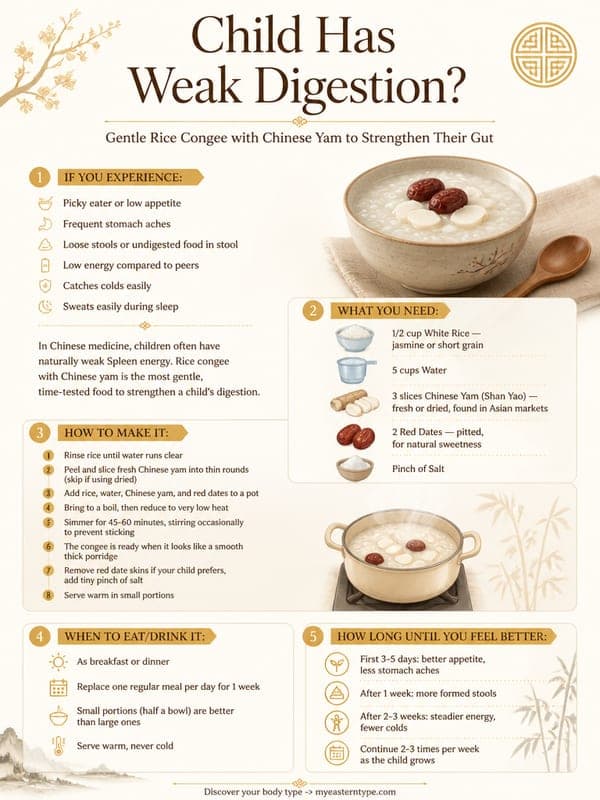
Don't Lose This Recipe
Pin this to your family wellness board so it's one tap away when your child needs it. Over 2,000 parents have saved these recipes already. Then take our free 5-minute body type quiz to learn which constitution runs in your family.
When to See a Doctor
This page describes traditional Chinese dietary philosophy. It is not medical advice and is not a substitute for evaluation by a licensed healthcare provider. Talk to your pediatrician if your child shows any of the following:
- Blood in the stool or black, tarry stools
- Persistent abdominal pain that wakes them at night
- Unexplained weight loss or failure to grow
- Repeated vomiting
- Chronic diarrhea lasting more than a few days
- Signs of dehydration
Curious which body type you are? Take the free 5-minute quiz.
Take the Free Quiz →Frequently Asked Questions
At what age is a child's Spleen considered fully developed in TCM?+
Is rice congee enough for breakfast for a growing child?+
How long until I notice improvement with traditional Chinese foods?+
My child refuses warm porridge. What can I do?+
Which body type is associated with weak digestion in children?+
Related Reading for Families
The adult version of the same pattern. Useful for parents who recognize the same signs in themselves, since digestion patterns often run in families.
The TCM Diet: Foundational Foods for Every Body TypeThe core food framework behind Chinese dietary therapy, with the warm and easily digested staples that suit both children and tired adults.
Chinese Medicine for Bloating: When the Spleen Cannot Keep UpBloating in children and adults often traces back to the same Spleen weakness. This page covers the adult side of the same pattern.
The Qi Deficient Body TypeWeak digestion in children often mirrors a Qi Deficient parent. Understanding your own constitution helps explain family patterns.
Discover Your Eastern Type
Take our free 5-minute assessment to explore which body type best matches your current wellness patterns.
Take the Free Quiz→