Chinese Medicine for Child Constipation: Foods That May Help (and Why Bananas Often Backfire)
8 min read · Eastern body wisdom for families
Quick Answer
When a child has not had a proper bowel movement in three or more days, Chinese medicine looks first at fluid and warmth. The intestines behave like a river that needs both moisture and a gentle current to keep moving. Two patterns commonly show up in constipated children. Intestine Dry presents as hard, pebble-like stools with thirst and dry lips. Spleen Qi Deficiency with sluggishness shows as infrequent stools that are not necessarily hard, with tiredness and small appetite. Moistening foods such as black sesame, cooked pear, walnuts, and warm honey water may help. Cold raw fruit, bananas in particular for many children, often makes the situation worse over time.
How Chinese Medicine Sees a Child's Constipation
Western pediatrics usually frames constipation as a fiber problem. Eat more whole grains, drink more water, the line goes. Sometimes that works. Sometimes it does not, and parents end up more frustrated, children more backed up, and bananas rotting on the counter.
Chinese medicine frames the intestines differently. They are not a tube that simply needs more bulk. They are an organ system that needs warmth to move, fluid to stay slippery, and a steady rhythm of eating and resting to stay regular. When any of those is off, the river slows. Stools sit, dry out, and get harder to pass. The cycle feeds itself.
This is why the common banana advice often misfires. Bananas are cold and sweet in TCM terms. For a child whose constipation is already a moisture-and-warmth problem, a daily cold banana is like adding ice to a slow-moving river. The fiber might be there, but the system still slows. Some children tolerate bananas fine. Many constipated children do not. The difference is the child's underlying pattern, not the banana itself.
Curious which body type you are? Take the free 5-minute quiz.
Take the Free Quiz →Constipation Patterns in Children
Constipation is not one thing. The right food depends on which pattern is closest to your child's picture.
| Pattern | Key Signs | Mechanism | Food Direction |
|---|---|---|---|
| Intestine Dry | Hard, pebble-like stools, dry lips, thirsty | Intestines lack the moisture to keep stool soft and moving | Moistening foods: sesame, pear, honey, walnut |
| Spleen Qi Sluggishness | Infrequent stools, not hard, tired, small appetite | Spleen cannot generate enough downward current | Warm tonics: millet, jujube, well-cooked root vegetables |
| Stomach Heat | Hard dry stools, bad breath, cranky, prefers cold drinks | Heat has dried out the intestinal fluids | Cooling moist foods: cooked pear, mung bean, lotus root |
| Liver Qi Stagnation | Stools that come in pellets, irritability, holds it in | Stress has tightened the system that should be relaxed | Aromatic relaxants: tangerine peel, fennel, mint |
What Causes Constipation in Children
Constipation in children rarely has a single cause. It is usually a stack of small daily mismatches that gradually slow the system down.
The cold-fruit loop
Bananas, raw pears, and big glasses of cold orange juice are often the first things well-meaning parents offer when a child is constipated. In TCM theory, all of these are cooling. For a child whose intestines already lack the warmth to move, more cold is the opposite of what helps. The fiber content matters less than the temperature pattern.
Not enough warm fluids
Most children drink water cold or room temperature, when what their intestines actually want is warm. A cup of warm water in the morning, especially with a small spoon of honey, is one of the simplest traditional practices for keeping the intestinal river moving. Cold water slows it.
Withholding, often at school or daycare
Many young children hold their stool at school because the bathroom feels unfamiliar or lacks privacy. Each time they hold, the stool dries out more, the next pass hurts, and the next time they hold longer. This is one of the most common patterns in children ages 3 to 6, and the solution is environmental, not dietary.
Heavy protein without enough warmth
A high-protein diet of cheese, meat, and eggs with few cooked vegetables or warm grains can be heavy on the Spleen. Without warmth to balance it, the system gets sluggish. This pattern shows up often in children who love dairy.
Antibiotics or recent illness
After antibiotics, a stomach bug, or a febrile illness, the digestive flora and the Spleen are both rebuilding. Constipation often shows up a week or two later, sometimes alternating with loose stools. The traditional approach is to focus on easy warm foods and avoid heavy raw fiber until things stabilize.
Foods That May Help a Constipated Child
These foods emphasize moisture, warmth, and gentle movement. None of them are harsh laxatives. They are the kinds of foods a Chinese grandmother would quietly add to a constipated grandchild's day.
| Food | TCM Property | How It May Help | How to Prepare |
|---|---|---|---|
| Black sesame seeds | Neutral, sweet | Classic TCM moistening seed for the intestines; used for centuries for childhood constipation | Toast lightly, grind, stir a teaspoon into porridge |
| Pine nut | Warm, sweet | One of the most lubricating nuts in TCM; gentle and well-liked by children | Small handful as a snack, or stir into rice |
| Pear, cooked | Cool, sweet | Generates fluids, moistens Lungs and Intestines; cooking reduces the cold quality | Steam with a little rock sugar, 20 minutes |
| Honey (over age 1) | Neutral, sweet | Mildly moistening; gently encourages bowel movement | One small spoon in warm water, morning |
| Walnut | Warm, sweet | Moistens intestines and supports Kidney energy; useful for dry-type constipation | 1 to 2 walnuts daily, chewed well |
| Peach | Warm, sweet | Moistening and gentle; in season, a few slices a day | Fresh, ripe, in small amounts |
| Warm soy milk | Cool, sweet | Plant-based moisture; warmer in temperature than cow's milk | Heat gently, no ice |
| Sweet potato with sesame oil | Neutral, sweet | Gentle bulk from sweet potato, lubrication from a few drops of toasted sesame oil | Steam and mash, drizzle a few drops of sesame oil |
| Seaweed (wakame, kelp) | Cold, salty | Softens and gently moves; useful when heat is part of the picture | In miso-style soup, small amounts |
Foods to Limit During a Constipation Phase
These foods are not harmful in themselves, but during an active constipation phase they tend to slow things further. Pull them back for two to three weeks and see what shifts.
- –Bananas, especially cold or under-ripe ones, which many children tolerate poorly
- –Astringent fruits like persimmon and guava, which can slow the intestines further
- –Excessive dairy, especially cheese and yogurt in large daily amounts
- –Dry crackers, toast, and dry bread without warm fluid alongside
- –Apple sauce in large amounts, since the pectin can firm stools
- –White rice in excess with no warm vegetables or broth
Daily Habits That Encourage Regularity
Food is only one part of the picture. The body's rhythm of bathroom habits often matters more than what is on the plate.
- 1.Warm water with honey, first thing in the morning. For children over one year. A small spoon of honey in a cup of warm water on an empty stomach gently wakes the intestines.
- 2.Bathroom sit 5 to 10 minutes after breakfast. The body's natural gastrocolic reflex fires after a warm meal. Make this a no-pressure routine, not a forced production.
- 3.Clockwise abdominal massage. With warm hands, gently rub your child's belly in clockwise circles for 2 minutes before bed. This follows the natural direction of the colon.
- 4.Light movement before bathroom time. A few jumps, a walk around the living room, or a stretch sequence helps things move. Sitting still is not a friend of regularity.
- 5.Warm bath before bed. A warm bath relaxes the Liver Qi, which is often part of the holding pattern in withholding children.
- 6.Foot warmth, especially in cold-type constipation. Cold feet pull warmth away from the core. Warm socks or a brief foot soak before bed is a small traditional habit with a real effect.
- 7.Reduce withholding triggers at school and daycare. Talk to teachers about bathroom access and privacy. Many children stop holding as soon as the bathroom feels safe.
A Family Routine: Black Sesame and Pear Porridge
This is the recipe traditional Chinese families turn to when a child has gone three or four days without a proper stool. It is gentle, mildly sweet, and easy for children to accept.
What you need
- 1/4 cup white rice
- 4 cups water
- 1 tablespoon black sesame seeds, lightly toasted and ground
- 1 small ripe pear, peeled and diced
- Optional: 1/2 teaspoon honey (over age 1 only)
How to make it
- 1. Rinse the rice. Combine with water in a pot.
- 2. Bring to a boil, then reduce to very low heat.
- 3. Simmer 30 minutes, stirring occasionally.
- 4. Add the diced pear and ground black sesame.
- 5. Simmer another 10 to 15 minutes until the rice is broken down and the porridge is soft.
- 6. Stir in a small amount of honey if using, just before serving.
- 7. Serve warm, in small portions.
When and how much
- Breakfast, or as the evening meal for 2 to 3 days
- Half a bowl for ages 2-5, full bowl for older kids
- Always warm, never cold
- Use for 3 to 5 days, then return to normal warm meals
What to expect
- Usually a softer, easier stool within 12 to 24 hours
- Less straining and smaller pebble size over 2 to 3 days
- After 5 to 7 days of consistent habits, more regular rhythm
- Long-term: keep warm fluid as a daily habit, return to this porridge as needed
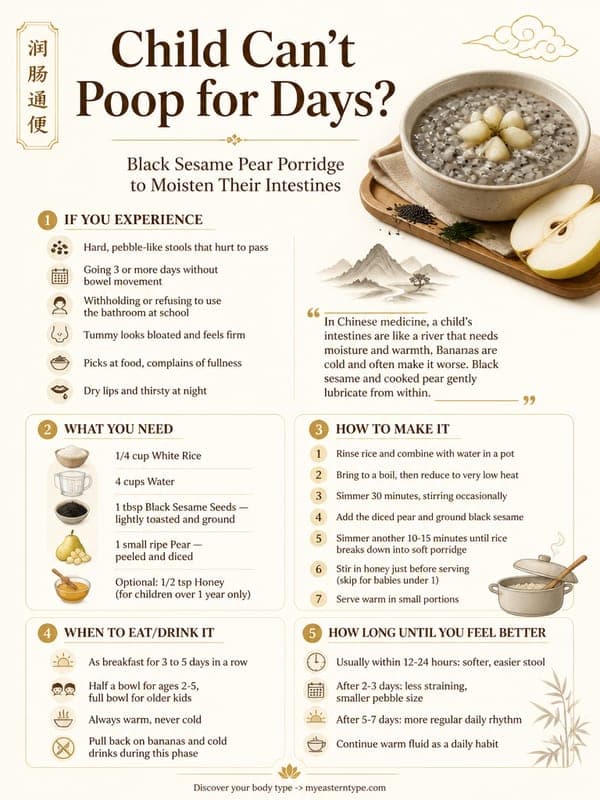
Don't Lose This Recipe
Pin this to your family wellness board so it's one tap away when your child needs it. Over 2,000 parents have saved these recipes already. Then take our free 5-minute body type quiz to learn which constitution runs in your family.
When to See a Doctor
This page describes traditional Chinese dietary philosophy. It is not medical advice and is not a substitute for evaluation by a licensed healthcare provider. Talk to your pediatrician if your child shows any of the following:
- No bowel movement for 5 or more days
- Severe abdominal pain, vomiting, or fever
- Blood in or around the stool
- Stool soiling in underwear (encopresis), which signals chronic retention
- Painful tears around the anus (fissures)
- Weight loss or refusal to eat
Curious which body type you are? Take the free 5-minute quiz.
Take the Free Quiz →Frequently Asked Questions
Why do bananas make some children's constipation worse?+
How many days without a bowel movement is too long for a child?+
Is fiber from raw vegetables better than cooked for constipation?+
Can abdominal massage really help a child poop?+
Which body type is most associated with childhood constipation?+
Related Reading for Families
Constipation is often a downstream sign of the same weak Spleen that drives general digestion trouble. Start here if your child also has picky eating or low appetite.
Chinese Medicine for Constipation: The Adult GuideThe adult version of the same pattern. Parents with sluggish digestion often see the same signs in their children.
What Is Qi? The Energy That Moves Everything, Including the BowelsConstipation is often a Qi problem, not just a fiber problem. Understanding Qi makes the whole framework click.
The Qi Deficient Body TypeA constitution prone to sluggishness, tiredness, and slow digestion. Runs in families.
Discover Your Eastern Type
Take our free 5-minute assessment to explore which body type best matches your current wellness patterns.
Take the Free Quiz→