Why Am I Always Tired? What Your Body Is Trying to Tell You
Based on 3,000 years of Eastern body wisdom
Quick Answer
When 8 hours of sleep still leaves you reaching for coffee by 10 AM, Chinese medicine looks past sleep quantity to Qi Deficiency, a pattern where your body lacks the fuel to recharge overnight. Roughly 15% of people fit this body type. A second pattern, Yang Deficiency, adds cold hands and feet to the same fatigue. Both may improve with warm cooked foods and consistent sleep before 11 PM.
If you're always tired even after a full night's sleep, you're not alone. You've probably heard "get more sleep" or "exercise more" so many times it makes you want to scream. But what if the problem isn't how much you sleep? What if your body is just running low on something sleep can't fix?
I spent years thinking I was just "not a morning person" or "lazy." Turns out, my body was low on Qi, the energy that powers everything from digestion to thinking clearly. Once I understood this pattern, things started making sense in a way they never had before.
This isn't about being dramatic. Chronic low energy affects your work, your relationships, your willingness to try new things. It quietly shrinks your life. Let's talk about what might actually be going on underneath.
Quick check: is this your pattern?
- ☐Eight hours of sleep still leaves you reaching for coffee by 10 AM
- ☐Your afternoon slump hits so hard you could nap under your desk
- ☐A single flight of stairs feels like a marathon
- ☐You stopped suggesting plans that require leaving the house
- ☐Colds go around the office and you catch every single one
- ☐By 8 PM you are running on fumes, even on days you did nothing strenuous
If four or more resonate, your body may be running on a smaller battery than others. The quiz can confirm which type.
Which Body Types Are Most Affected
Chinese medicine identifies 9 distinct body types. This symptom shows up most often in the following:
The primary type behind chronic fatigue. The hallmark is feeling wiped out even after adequate rest. People with this type often have a soft voice, sweat easily, catch colds more often, and prefer sitting over standing. It's like their battery is genuinely smaller than other people's.
Common Signs
If you also sweat easily with little exertion and your voice fades by afternoon, this pattern is a strong candidate.
Take the Quiz to confirm >These folks feel tired AND cold. Their internal heater is underpowered, so their body cuts circulation to the extremities to protect core warmth. If you're always tired and your hands are like ice cubes, this might be your pattern.
Common Signs
When being cold bothers you as much as being tired, your internal heater may be the real bottleneck.
Take the Quiz to confirm >Which Pattern Sounds Like You?
Always being tired is not one pattern. Chinese medicine distinguishes four common roots, each with a different entry point.
| If This Sounds Like You | The Signal | Start Here |
|---|---|---|
| Tired, but otherwise warm | Battery runs low without other symptoms | Qi Deficient path: congee, jujube dates, gentle movement |
| Tired and cold hands or feet | Internal heater is also underpowered | Yang Deficient path: ginger, lamb, cinnamon, warm cooked foods |
| Tired and heavy, foggy head | Dampness is weighing down your energy | Phlegm Damp path: adzuki beans, coix seed, green tea |
| Tired and irritable, tight chest | Energy is stuck rather than depleted | Qi Stagnant path: rose tea, citrus, evening walk |
Curious which body type you are? Take the free 5-minute quiz.
Take the Free Quiz →How Chinese Medicine Views This
Let's be honest: being tired all the time isn't normal, even though it's common. The usual suspects are poor sleep, bad diet, too much screen time, or not enough exercise. And sure, those things matter. But many people fix all of those and still feel like a phone stuck on 5% battery. That's when it's worth looking deeper.
Sometimes it's low iron, thyroid issues, or vitamin deficiencies. Your doctor can check those. But here's the thing a lot of people run into: the blood work comes back totally fine, and you're told everything looks normal. Great. But you still feel like garbage. That gap between "normal test results" and "I can barely get through the afternoon" is exactly where Eastern body wisdom has something useful to say.
Chinese medicine doesn't look at your blood. It looks at how your body functions: how well you digest, how warm your hands are, whether you sweat easily, how your voice sounds. These seemingly random details form a pattern, and that pattern tells a story about what your body needs.
In Traditional Chinese Medicine, the most common pattern behind "always tired" is called Qi Deficiency. Qi is your body's vital energy, think of it as the fuel running every single function, from your heartbeat to your thoughts. When Qi is low, nothing breaks exactly, but everything runs slower and costs more effort.
Qi Deficiency is often linked to a few root causes: prolonged stress that wears you down over months, recovering from an illness that your body never fully bounced back from, eating too many cold and raw foods that force your digestive system to work overtime, or simply a constitutional tendency you were born with. The good news is that Qi can be supported and built up over time with the right approach.
Key Concept
Qi Deficiency(气虚)
Qi Deficiency is a Chinese medicine pattern where your body's vital energy runs low. Think of it as a smaller battery than other people have: you charge it the same way through sleep and food, but it holds less and drains faster. Common signs include a soft voice, easy sweating with little exertion, frequent colds, and fatigue that doesn't lift with rest.
A Simple Analogy
Imagine your body is a car. Western medicine checks the oil, the fuel, the spark plugs. If those test fine, the car is "healthy." Chinese medicine goes a step further and asks: but how does the engine feel when you drive it? Does it struggle on hills? Does it idle roughly? Those functional experiences matter, even if the diagnostics say everything is fine.
Eastern vs. Western Perspective
Two different lenses on the same symptom.
| Topic | Western Medicine | Chinese Medicine |
|---|---|---|
| What is being measured | Blood tests, hormone levels, vitamin panels | How the body functions: digestion, warmth, energy levels, voice strength |
| Definition of "healthy" | All test results within normal range | Body functions smoothly with energy to spare, not just absence of disease |
| View of fatigue | Symptom to be linked to a diagnosable condition | Pattern indicating the body's energy system needs support |
| Approach | Treat the diagnosed condition if found | Support Qi production through diet, lifestyle, and body type awareness |
Simple Changes That May Help
You don't need to flip your life upside down. Small shifts can stack up surprisingly fast.
Switch to Warm, Cooked Foods
Your digestive system in TCM is like a cooking pot. Cold, raw ingredients force it to spend energy heating everything up before digesting. For someone already low on Qi, that's energy you can't afford to waste. Warm soups, stews, and congee are much easier on your system.
Start Your Day with Congee
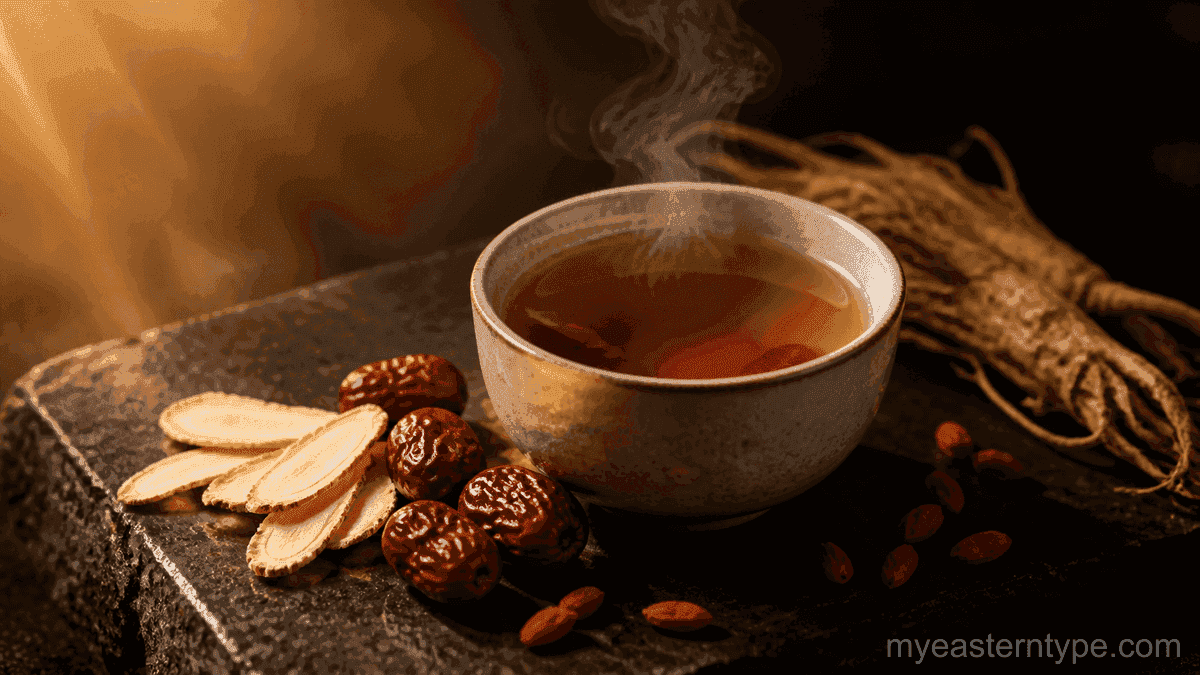
Congee (rice porridge) is the number one recovery food in Chinese households because it takes almost zero digestive effort and delivers steady nourishment. Add a cup of warm ginger tea with a few jujube dates on the side. Most people with Qi Deficiency notice a real difference within two weeks.
Go Easy on Caffeine
TCM views coffee as borrowing energy from tomorrow to spend today. It doesn't create new Qi. It just stimulates what's already there. Over time, the debt catches up. Try cutting back by half and replacing some cups with warm ginger tea or ginseng tea.
Move, But Gently
Heavy workouts can actually drain Qi further if you're already depleted. Think walking, gentle yoga, tai chi, or even just 15 minutes of slow stretching. The goal is circulation, not exhaustion. You want to wake your body up, not beat it into submission.
Get to Bed Before 11 PM
In TCM, the body clock matters. The hours before midnight are considered the most restorative for your Qi. Staying up past 11 consistently is like trying to fill a bucket with a hole in it. You can catch up later, but you'll never quite recover what you lost during those prime hours.
When to See a Doctor
If your fatigue is severe, worsening, or accompanied by unexplained weight loss, dizziness, or shortness of breath, see a doctor first to rule out underlying medical conditions. TCM constitution patterns complement but do not replace medical evaluation.
Common Questions About This Symptom
Is this different from just being tired after a long day?+
How is this different from chronic fatigue syndrome?+
Could this be a thyroid problem instead?+
Related Guides
Frequently Asked Questions
Why do I wake up tired even after 8 hours of sleep?+
Can changing my diet really fix chronic fatigue?+
Is being always tired the same as chronic fatigue syndrome?+
What body type is most associated with being always tired?+
What Foods May Help
We put together a full food guide for this symptom, including what to eat, what to avoid, and a simple daily meal plan.
See the food guide >Discover Your Eastern Type
Take our free 5-minute assessment to explore which body type best matches your current wellness patterns.
Take the Free Quiz→This content is for educational and informational purposes only and is not medical advice. Always consult a qualified healthcare professional before making changes to your diet or lifestyle, especially if you managing a health condition. Individual results may vary.