Summer Travel by Body Type: Why the Same Trip Exhausts Some People and Energizes Others
A 10-day holiday can leave you refreshed or completely drained, depending on your constitution. Here is how each of the nine body types responds to summer travel, and what to do about it.
Two Travelers on the Same Flight
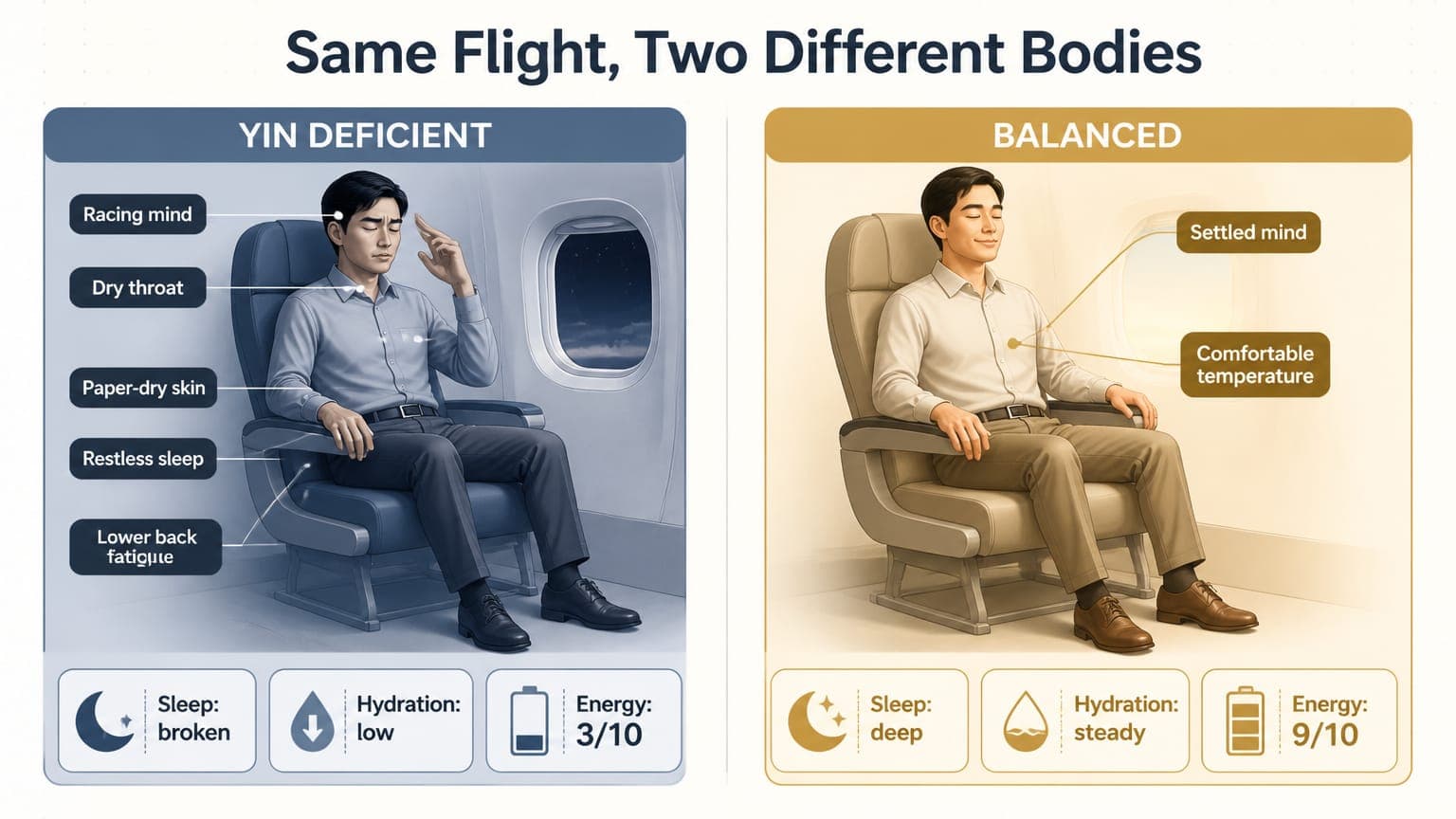
Picture two travelers sitting next to each other on a flight from London to Bangkok. Same departure time, same recycled cabin air, same uninspiring meal. One steps off the plane feeling refreshed, ready to drop the bags at the hotel and head straight for the river. The other arrives with a scratchy throat, a faint headache, and a vague sense that something is already off. They will spend the next three days catching up. We tend to explain this difference with phrases like good sleeper or bad traveler, but Chinese medicine frames it differently. The body that takes the trip matters more than the trip itself. Each of the nine body types, what TCM calls constitutions, has its own chemistry with change. New time zones, new food, new climate, new daily rhythm. Some constitutions thrive on that stimulus. Others are quietly drained by it. This guide is not a list of universal tips. It is a way of reading your own body's travel pattern, so the parts of the trip that will cost you the most energy are not a surprise.
Curious which body type you are? Take the free 5-minute quiz.
Take the Free Quiz →Same Flight, Two Different Bodies
What Travel Actually Does to a Body
- •Time zone disruption. The internal clock, tied to sunlight and meal times, takes several days to fully shift. Eastward flights are usually harder than westward, because shortening the day is harder on the body than lengthening it.
- •Cabin dryness. Airplane humidity sits around 10 to 20 percent, drier than most deserts. Skin, eyes, throat, and lung tissue all lose moisture quietly across a long flight.
- •Prolonged sitting. Hours of immobility stagnate Qi and Blood. The heavy, stiff feeling on arrival is not just fatigue. It is stagnation that has not yet been moved.
- •Diet disruption. New food, irregular meal times, restaurant portions, and unfamiliar ingredients all hit the Spleen at once. Most travelers feel the digestive impact on day two, not day one.
- •Climate contrast. Stepping from a heated airport into tropical heat, or from a warm street into an air-conditioned hotel room, forces the body to constantly recalibrate. Each transition has a small cost.
Jet Lag: A 36-Hour Timeline
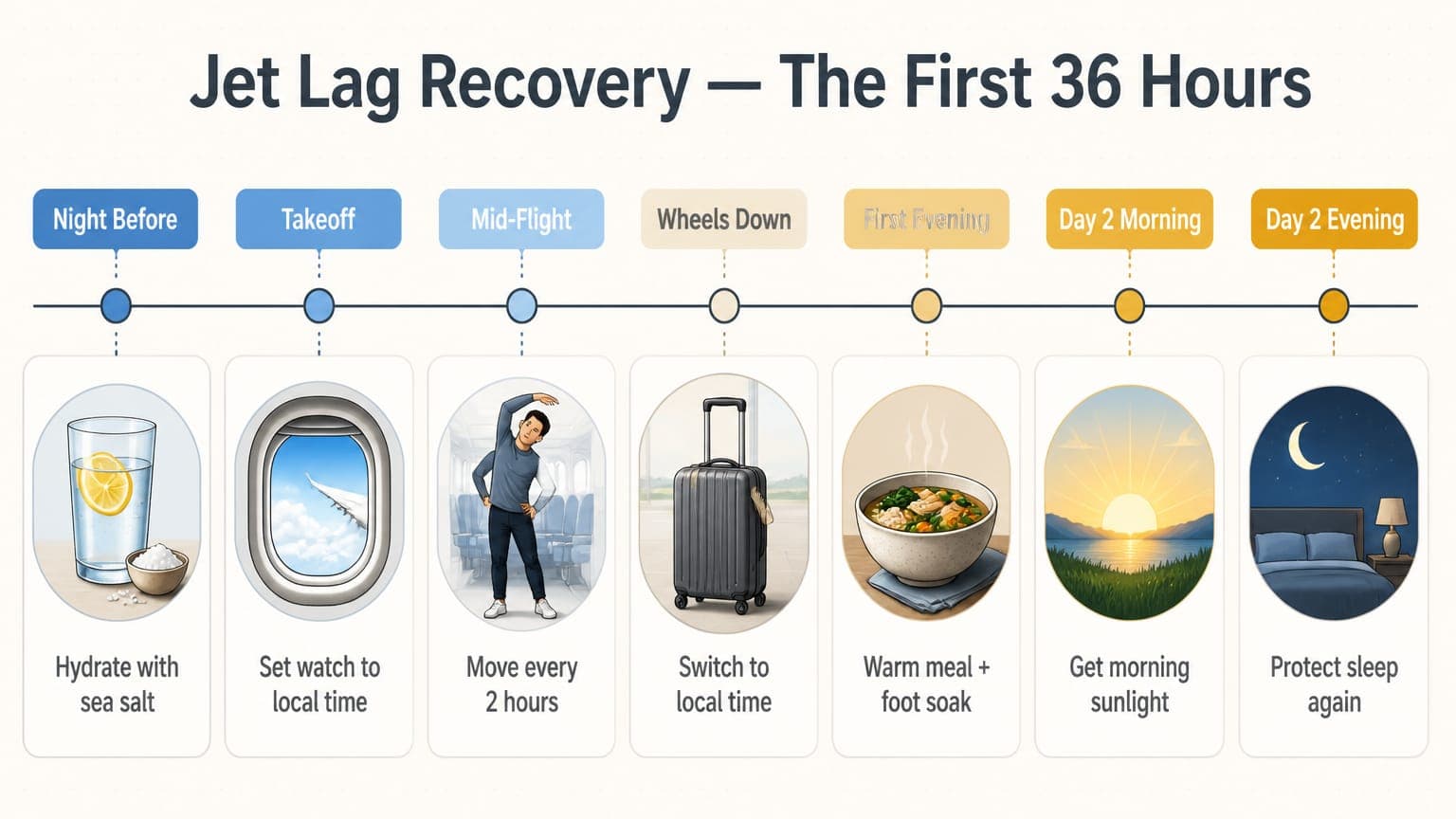
Most jet lag advice is a list of vague principles. A timeline is more useful. Below is a sequence for a long eastward flight, the kind most people struggle with. For westward flights, the same steps apply, but with sleep shifted later instead of earlier.
- 1
The Night Before (Hour -12)
Start hydrated, well before the airport. Drink more water than usual through the day, and add a pinch of sea salt or a teaspoon of honey to one glass to help the body hold onto it. Skip alcohol the night before a flight. It is heating and damp-generating in TCM, and it disrupts the deep sleep you will need.
- 2
At Takeoff (Hour 0)
Set your watch and phone to the destination time zone the moment you sit down. The mental shift starts on the plane. Decide now whether you should sleep on this flight, based on what time it is where you are going, not where you left.
- 3
Mid-Flight (Hour +4)
Move every two hours, even just to stand and stretch in the aisle. Walk to the back of the plane and back. Drink warm water or herbal tea, never coffee, never alcohol. If it is night at your destination, put on an eye mask and try to sleep. If it is daytime there, stay awake and read.
- 4
Wheels Down (Hour +10)
Once landed, switch fully to local time. Stop calculating what time it is back home. That mental habit extends jet lag by days. Move through customs and baggage with the posture of someone at the destination, not the posture your tired body wants.
- 5
First Evening (Hour +16)
Eat a small, warm, simple meal. Congee, clear soup, or rice with steamed vegetables. Skip the welcome dinner at a famous local restaurant. That pleasure is better saved for day two or three, when your digestion has reset. Take a warm foot soak for ten to fifteen minutes before bed to draw energy down from the head and settle the mind.
- 6
Day Two Morning (Hour +24)
Get sunlight on your face as early as you can. Fifteen to thirty minutes of outdoor light, ideally while walking, resets the internal clock faster than any supplement. Eat a warm breakfast, even if you are not very hungry, to lock in the local rhythm.
- 7
Day Two Evening (Hour +36)
By the second evening, most of the heavy lifting is done. Resist the temptation to celebrate with a heavy meal and drinks. One more early night secures the shift, and from day three onward the new rhythm usually holds.
Jet Lag Recovery Timeline
If you are not sure which of the nine body types you are, the free 5-minute quiz may help. The result comes with travel-related pointers for your specific constitution, so the parts of the next trip that will cost you the most are not a surprise.
Take the Free Quiz →When the Battery Runs Low: Qi Deficient Travelers
There is a particular kind of traveler who falls asleep on the airport bench before the gate is even announced. They start the trip excited, push through the first day with effort, and wake up the next morning feeling as if a week has already passed. If that sounds familiar, you likely belong to the Qi Deficient constitution. The internal battery is smaller than average, and every hour of travel draws from it. The cost shows up as heaviness after meals, sensitivity to motion, weak appetite in unfamiliar time zones, and a stubborn tendency to catch whatever cold is circulating in the cabin. A Qi Deficient traveler is not someone who should avoid long trips. They are someone who should plan as if each travel day costs the energy of two ordinary days. That means sleeping well for several nights before departure, rather than finishing a packed work week and jumping straight on a plane. It means scheduling nothing important on day two. It means carrying ginger tea bags for the nausea that surfaces on long drives and winding mountain roads, and jujube dates for the mid-afternoon energy dip. The trap is the temptation to push through. Qi Deficient travelers often describe themselves as lazy, when the truth is their system genuinely runs out of fuel faster than others'. Treating that as information, rather than a personal failing, is the most useful shift they can make before packing.
Dry Air, Dry Body: The Yin Deficient Traveler
If your skin feels paper-dry by the end of a long flight, if you wake at 3 AM with a racing mind even in a comfortable hotel bed, and if the back of your throat feels like sandpaper for days after you arrive somewhere warm, you may belong to the Yin Deficient constitution. Airplane cabins are the first problem. Cabin humidity sits around ten to twenty percent, drier than most deserts, and Yin Deficient travelers feel it before anyone else. Hotel air conditioning continues the work. By the second night, sleep, already fragile for this type, becomes something of a negotiation. Destination choice matters more for this constitution than for any other. A humid coastal town in midsummer will treat a Yin Deficient traveler gently. A dry inland city at high altitude will quietly deplete them. The same person who thrives on a beach holiday in Thailand can come back from a desert trip in Arizona feeling ten years older. A few small things reduce the cost. Sip water steadily rather than in occasional big gulps, and add a pinch of sea salt or honey to support absorption. Carry a small bottle of pear or loquat syrup for the throat. Avoid coffee and alcohol in flight, both are drying, and the cold temperature of an iced drink does not cancel that effect. A thin layer of coconut oil inside the nostrils and a light moisturizer on the face feel small but reduce the dried-out drag that builds across a long flight.
The Other Seven Types: A Quick Read
| Body Type | Travel Pattern | Watch Out For |
|---|---|---|
| Yang Deficient | Often feels better on holiday, especially somewhere warm; external heat balances internal cold | Air-conditioned restaurants and iced breakfasts that quietly undo the benefit of the warmth |
| Phlegm Damp | Heavy and puffy on long flights; groggy mornings are common | Rich restaurant food day after day; plain warm meals drain the dampness faster |
| Damp Heat | Struggles in tropical humidity; skin breakouts and irritability flare within days | Beach holidays in sticky heat. Dry mountains or deserts suit this type far better |
| Blood Stasis | Joint stiffness and poor circulation on long-haul flights; swollen ankles are typical | Compression socks, aisle walks, and stretching matter more for this type than any other |
| Qi Stagnant | Reacts strongly to delays, crowding, and loss of control; mood drives the experience | A rigid itinerary. Loose plans and daily walks bleed off the tension before it builds |
| Sensitive | Picks up on dust, pollen, and unfamiliar food additives quickly; reacts before others notice | A cotton face mask, familiar tea bags from home, and peppermint oil for mild nausea |
| Balanced | Adapts well; usually the traveler who never complains and genuinely enjoys the trip | Overconfidence. Even a strong constitution has limits across several late nights and irregular meals |
How Fast Each Type Settles In
One of the most useful numbers to know about your own constitution is how long it takes to feel normal after arrival. The chart below is a rough estimate based on common patterns. Age, fitness, hydration, and the direction of travel all shift these numbers, but the relative gap between types tends to hold.
A Small Kit for Each Constitution
- •Qi Deficient: Ginger tea bags for motion and fatigue, jujube dates for the mid-afternoon dip, and a sleep mask for naps on travel days.
- •Yang Deficient: A thin abdominal wrap or scarf for air-conditioned restaurants, ginger tea, and a small packet of brown sugar for warm drinks.
- •Yin Deficient: Pear or loquat throat syrup, a small jar of honey, and a light facial moisturizer. Skip airplane coffee entirely.
- •Phlegm Damp: Dried tangerine peel (chen pi) for tea, a packet of coix seed powder, and loose comfortable clothing to reduce the heavy feeling.
- •Damp Heat: Green tea bags, mung bean powder for a cooling drink, and a light non-greasy skin cream. Stick to breathable cotton clothing.
- •Blood Stasis: Compression socks for the flight, a small bottle of rose or safflower oil for stiff joints, and a stretch band for short mobility breaks.
- •Qi Stagnant: Rose tea bags, which move Liver Qi, a small notebook for processing tension, and walking shoes you actually like wearing.
- •Sensitive: A silk or cotton face mask for dusty destinations, familiar herbal tea bags from home, and a small bottle of peppermint oil for nausea.
- •Balanced: Ginger tea and a refillable warm water bottle. The basics carry this type a long way.
Three Holidays, Three Different Stress Patterns
One Holiday, Three Different Readings
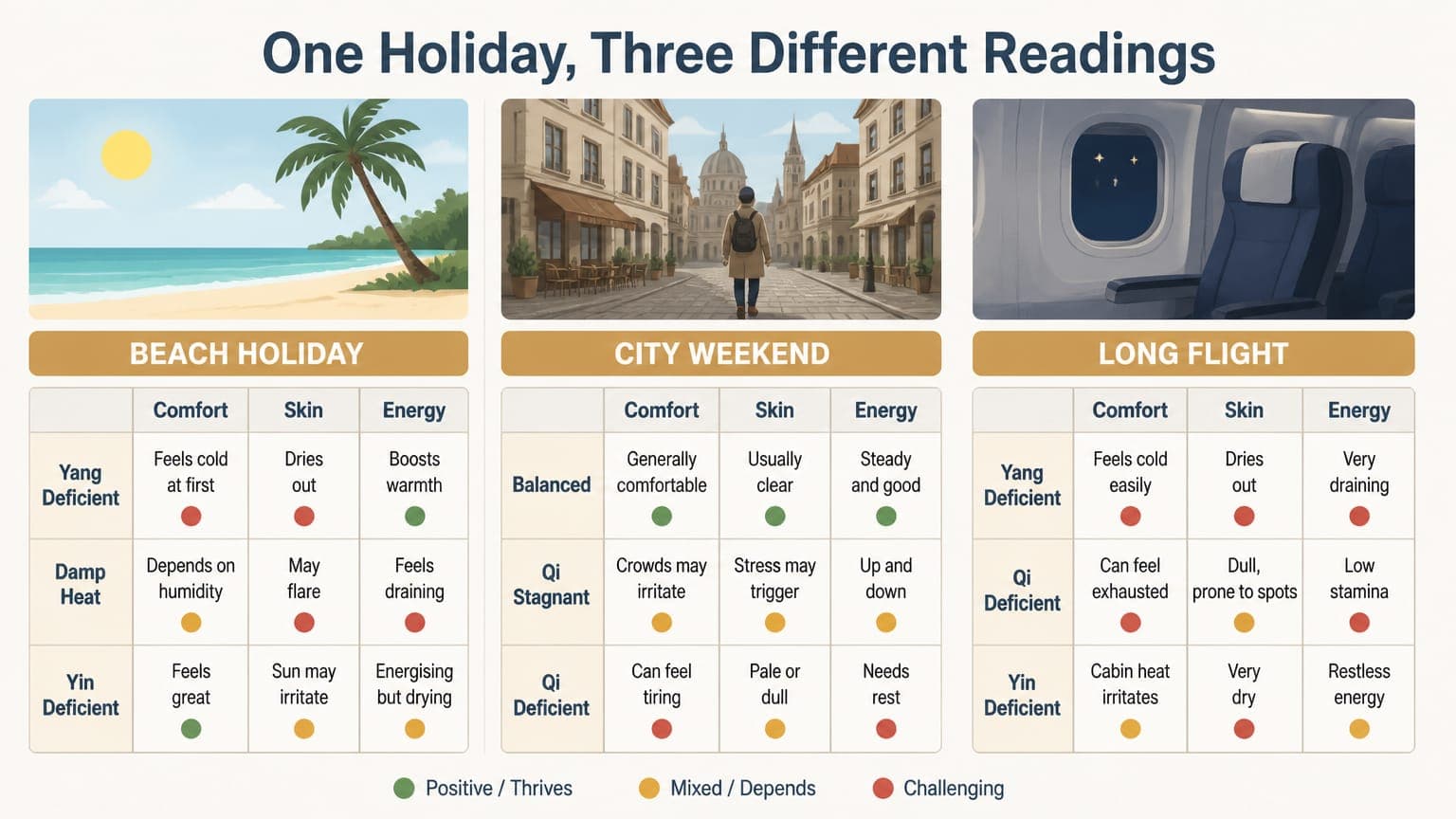
The same summer holiday can mean very different things to different constitutions. The three scenarios below are not mistakes to avoid. They are patterns to recognize. Each one shows how the same situation lands differently depending on the body that meets it.
The Beach Holiday in the Tropics
A Yang Deficient traveler arrives at a humid coastal town and feels better than they have in months. The external warmth meets their internal cold and the two balance out. They eat grilled fish and mango, sleep deeply, and return looking younger. A Damp Heat traveler arrives at the same beach and within 48 hours has a fresh cluster of skin bumps, a heavy feeling behind the eyes, and a creeping irritability they cannot explain. The same humidity that balances one constitution overloads another. A Yin Deficient traveler does well on the same trip if the air is humid, and struggles if it is dry. The coast of Thailand in July suits them. The coast of California in September does not. The trip is not the variable. The body is.
The Long City Weekend
A long weekend in Rome, Paris, or New York means hours of walking, late dinners, and irregular meals. A Qi Stagnant traveler thrives here, because the constant movement keeps Liver Qi from settling into frustration. A Balanced traveler handles the pace well, as long as sleep is protected. A Qi Deficient traveler starts strong and fades by day two. The walking is not the problem. The late dinners and skipped breakfasts are. By Saturday afternoon they are running on fumes, and the Sunday flight home feels like a rescue mission. A Phlegm Damp traveler feels heavy and puffy across the whole trip. Restaurant food, especially the rich sauces and cheese that define these cuisines, builds dampness faster than their system can clear it. Plain meals and morning walks are the difference between a good weekend and a sluggish one.
The Cross-Time-Zone Trip
A long-haul flight to East Asia or the Americas is the ultimate constitution test. Yang Deficient and Balanced travelers usually land, sleep one early night, and are functional the next morning. Qi Deficient travelers need three or four days to feel like themselves again. The fatigue compounds across time zones because they cannot sleep well at the wrong local time, and cannot stay awake at the right one. Yin Deficient travelers struggle most with the dry cabin air and the disrupted sleep cycle. They are the type most likely to come back from a long-haul trip with a cold or a sore throat, because their defensive Qi was thinned across the flight. Knowing this in advance changes what you pack, what you book for day one, and how early you go to sleep on the first night. None of these are universal tips. They are specific to the constitution taking the trip.
A Note Before You Pack
Travel is one of the most reliable tests of constitution. The body that takes the trip is the body that comes home. The same flight, the same meal, the same climate can restore one person and deplete another, and neither is doing it wrong. If your last holiday left you flattened for a week, that is information. If your partner comes back glowing while you come back with a sore throat, that is information too. The next trip does not have to be smaller. It just has to be shaped around what your body actually needs. Warm meals where they matter, sleep where it counts, and a destination that suits the constitution taking you there.
Related Articles
Frequently Asked Questions
Can I figure out my body type from how I react to travel?+
Why do I always catch a cold after flying?+
Is jet lag worse going east or west?+
What is the single most useful thing I can pack?+
Should I exercise on arrival day?+
Discover Your Eastern Type
Take our free 5-minute assessment to explore which body type best matches your current wellness patterns.
Take the Free Quiz→This article is for informational and educational purposes only and is not medical advice. Always consult a qualified healthcare professional for medical concerns.