Back-to-School by Body Type: Why Some Kids Bounce In While Others Drag
Some children walk into their classroom on day one like they belong there. Others come home exhausted, teary, or with a stomach ache. Their body type may explain why.
Why September Hits Different Kids Differently
In Chinese medicine, a child's reaction to going back to school may be closely tied to their body type, what TCM calls their constitution. Qi Deficient children often come home pale and spent, barely able to hold a conversation about their day. Qi Stagnant children may complain of tummy aches or headaches each school morning, with no clear physical cause. Damp Heat types might break out in rashes or spots during the first stressful week. A child's constitution is not a diagnosis. It is a pattern of strengths and weak points that shapes how their body responds to change, pressure, and new routines. Knowing your child's type may help you prepare for the parts of September that will cost them the most energy. Every September, teachers see the same pattern repeat. Some children walk into their new classroom like they belong there, make a friend within the first recess, and come home buzzing with stories. Others drag through the school gate, cling to a parent's hand, and return home withdrawn, tearful, or complaining of a stomach ache that no one can find a reason for. Same school, same teacher, same curriculum. Different bodies. Chinese medicine does not frame this as good behavior versus bad behavior. It frames it as a question of constitution. A child who runs low on Qi will struggle with the sustained output that a full school day demands. A child whose Liver Qi tends to tighten under stress will show it through the gut, not through words. The nine body types each carry their own weak point, and September is exactly the kind of pressure test that exposes it.
Curious which body type you are? Take the free 5-minute quiz.
Take the Free Quiz →The Nine Body Types at School Drop-off
| Body Type | First Week Vibe | What Drains Them | What May Help |
|---|---|---|---|
| Qi Deficient | Pale and spent by pickup | Sustained mental and social output | Warm cooked breakfast, early bedtime |
| Qi Stagnant | Tummy aches and reluctance at the gate | Emotional pressure and new routines | Movement before school, time to talk |
| Damp Heat | Breakouts and irritability in week one | Heavy lunches and sticky heat | Light cooling foods, less sugar |
| Yin Deficient | Dry throat, restless sleep, distracted | Hot classroom and poor hydration | Hydrating foods, pear and lily bulb |
| Yang Deficient | Cold hands, sluggish in the morning | Early chill and cold drinks | Warm food, layer up, ginger tea |
| Phlegm Damp | Foggy, heavy, hard to focus | Dairy and sweets after school | Light meals, movement, less damp food |
| Blood Stasis | Clumsy, dark circles, growing pains | Sitting still for long stretches | Stretching, movement breaks, warm feet |
| Sensitive | Sneezing, itchy skin, reactive | Dust, chalk, new environment | Clean uniform, gentle soap, airy room |
| Balanced | Settles in within a few days | Mostly fine, watch sleep debt | Normal routine, light on screen time |
Nine Body Types at a Glance
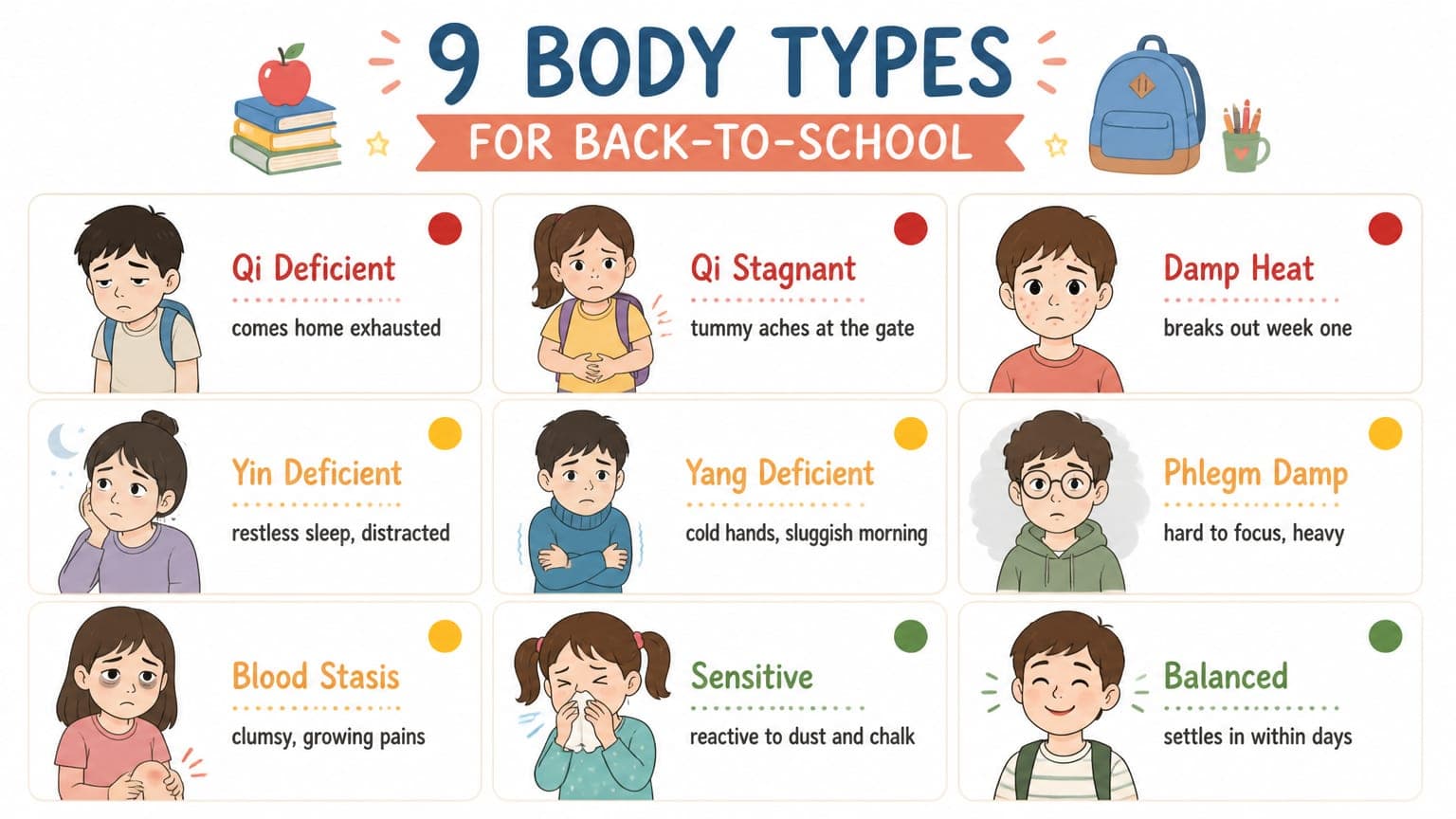
Every child carries a constitution they did not choose. Knowing your child's body type may help you stop reading their September struggles as bad behavior, and start reading them as a pattern you can actually support. Take the free 5-minute quiz to find out which of the nine body types your child leans toward.
Take the Free Quiz →The Qi Deficient Child: The One Who Comes Home Exhausted
The Qi Deficient child is the one who walks out of the school gate looking like the day already beat them. Pale, quiet, maybe a little sweaty on the forehead even though it was not hot. You ask how school was, and you get a one-word answer, not because they are being rude but because they genuinely do not have the energy to give you more. By the time they have walked home, dropped their bag, and sat down, they may look ready for bed, and it is only four in the afternoon. In Chinese medicine, Qi is the body's daily fuel, the energy that powers talking, thinking, moving, and digesting. A Qi Deficient child starts the day with a smaller tank than their peers. A full school day of paying attention, following rules, navigating friendships, and sitting still drains that tank by mid-afternoon. They are not lazy. They are not faking it. Their constitution simply asks for more recovery time than the school schedule allows. What may help is a warm, cooked breakfast rather than cold cereal or nothing at all. Congee, eggs, or warm oats support the Spleen, the organ Chinese medicine links with turning food into usable energy. An early bedtime, ideally before nine, protects what little Qi they have for the next day. Skip the temptation to fill their afternoons with clubs and lessons. A Qi Deficient child often needs a quiet hour of rest before homework, not another demand on their reserves. If the exhaustion is severe or persistent, a conversation with their pediatrician is worth having, to rule out anything beyond constitution.
The Qi Stagnant Child: The One Who Gets Tummy Aches Before School
The Qi Stagnant child is the one who feels fine all weekend and develops a stomach ache every weekday morning, usually right around the time the school bag gets picked up. The ache is real. It is not invented. It just does not have the kind of cause a scan or a blood test can find, which is exactly why it frustrates parents and worries teachers. In Chinese medicine, the Liver is responsible for the smooth flow of Qi throughout the body, and it is the organ most sensitive to emotional pressure, frustration, and change. When a child feels stretched by a new routine, a difficult classmate, or the simple pressure of performing, that flow can tighten and stall. A stalled Liver Qi tends to show up through the gut, because the Spleen and Stomach sit right next door. The result is a child whose worry announces itself as a tummy ache, a headache, or a sudden need to use the bathroom right before leaving the house. What may help is movement before school. A short walk, a few stretches, even dancing to one song can get Qi flowing again and ease the tightness before the day starts. It also helps to leave space in the morning for them to talk if they want to, rather than rushing from bed to car. Pressing a child to explain why their stomach hurts usually makes it worse. Quiet company works better than interrogation. If the pattern continues for more than a few weeks, or if the pain is severe, a pediatrician should be involved to make sure nothing else is going on.
The Damp Heat Child: The One Who Breaks Out in the First Week
The Damp Heat child is the one who walks into the first week of school with clear skin and walks out of it with a rash, a cluster of spots, or an itchy patch that was not there on Monday. The classroom is warm, the playground is sweaty, and lunchbox food is often sweeter and heavier than what they eat at home. For a Damp Heat constitution, that combination can be too much. In Chinese medicine, Damp Heat describes a pattern where internal moisture and warmth get stuck together and try to exit through the skin. The first stressful week of school, with its irregular meals, less water, and more heat, is a classic trigger. Your child may also seem more irritable than usual, and their tongue might look more coated than normal. What may help is lighter food through September. Less fried food, less dairy, less sugar, and more cooling options like cucumber, mung bean soup, and pear. Make sure they actually drink water during the school day, not just at home. If a rash looks infected or spreads quickly, have it checked by a pediatrician rather than assuming it is purely constitutional.
The Week Before School: A Simple Timeline
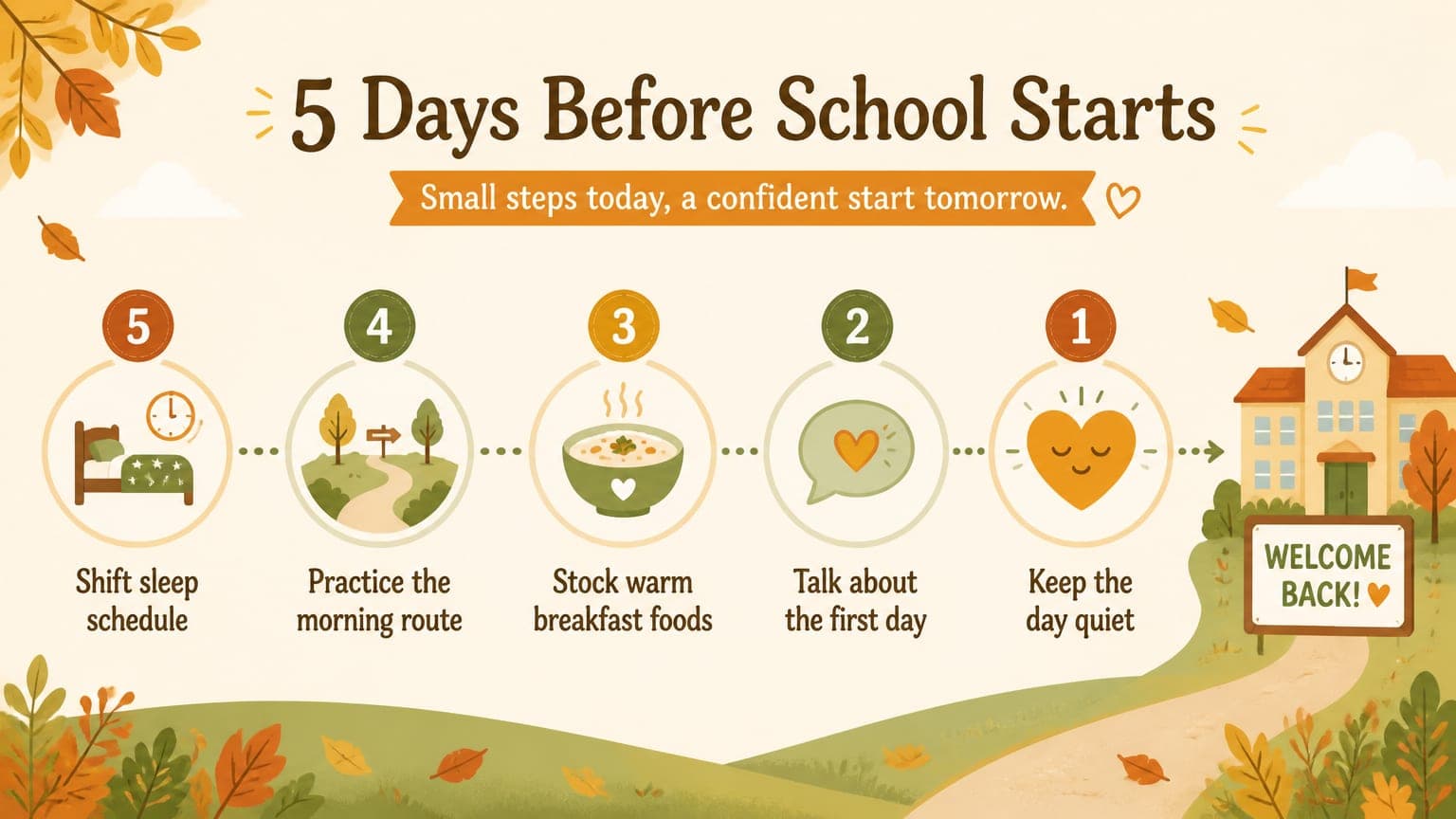
5 Things to Do the Week Before School Starts
- •Shift the sleep schedule five days early. A child's internal clock cannot reset in one night. Move bedtime and wake-up time fifteen minutes earlier each day during the last week of August, so the first school morning does not arrive as a shock to their system.
- •Practice the morning route once or twice. Walk or drive the route to school at the actual time you will need to leave. This lowers anxiety for Qi Stagnant and Sensitive types especially, because the unknown becomes familiar before the pressure is real.
- •Stock the kitchen for warm breakfasts. Congee, oats, eggs, and warm soups support a child's Qi far better than cold cereal or a skipped meal. Have the ingredients ready before the first morning rush, so a warm breakfast is easy rather than a project.
- •Talk about the day, not the year. Big talks about the whole school year can overwhelm a child. Talk instead about the first day, the first recess, the first lunch. Small, concrete pictures are easier for a child to carry than abstract expectations.
- •Leave the first week quiet. Do not book after-school clubs, playdates, or lessons in the first week. Most body types need more recovery time than parents expect. An empty calendar gives their body room to settle into the new rhythm.
The First-Day Breakfast That May Help
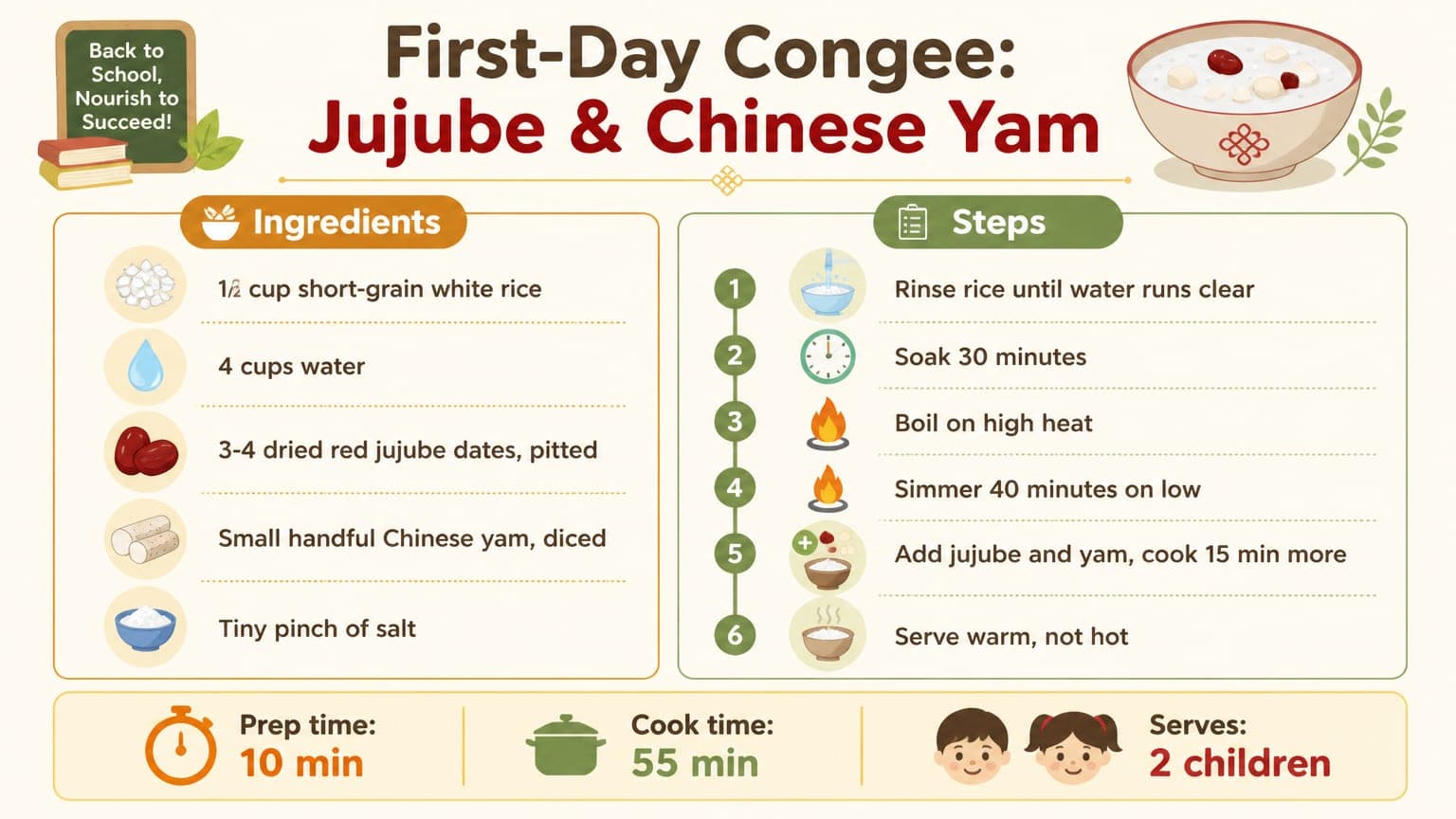
For a nervous child on the first morning of school, a warm, soft, easy-to-digest breakfast is one of the simplest things you can offer. Congee with jujube dates and Chinese yam is a traditional choice, because both ingredients support the Spleen without burdening it. Here is how to make it the morning before, or the night before and gently reheated.
- 1
Rinse half a cup of white rice
Use short-grain white rice for the softest texture. Rinse twice under cold water until the water runs mostly clear. This removes excess starch and stops the congee from turning gluey. Half a cup of dry rice is enough for two child-sized portions.
- 2
Soak the rice for thirty minutes
Cover the rinsed rice with water and let it sit for half an hour. Soaking softens the grain so it breaks down faster during cooking, which gives congee its signature silky texture. Drain before moving to the next step.
- 3
Add water at a one-to-eight ratio
For half a cup of rice, use four cups of water. This ratio produces a congee that is soft enough for a child's stomach first thing in the morning, without being too thin. A clay pot or heavy saucepan works best. Avoid iron, which can affect the color.
- 4
Bring to a boil, then simmer for forty minutes
Bring the pot to a rolling boil on high heat, then reduce to the lowest possible flame. Stir occasionally so the rice does not stick to the bottom. After about forty minutes the grains should have broken down into a soft porridge. A skin forming on top is normal and fine.
- 5
Add jujube dates and Chinese yam
Pit and slice three to four dried red jujube dates, and add a small handful of peeled, diced Chinese yam, fresh or dried. Both are traditional Spleen-supporting foods in Chinese medicine. Stir them in during the last fifteen minutes of cooking, so they soften but do not fall apart completely.
- 6
Serve warm, not hot
Ladle into a bowl and let it cool until it is warm but comfortable to eat. This congee is gentle on a child's stomach on a morning when they may be nervous and eating less than usual. A small pinch of salt is fine. Avoid sugar, which can undo the settling effect you are aiming for.
A First-Day Breakfast That Settles the Stomach
Related Articles
Frequently Asked Questions
Which body type struggles most with going back to school?+
My child gets a stomach ache every school morning. Is that real?+
Should I change my child's diet before school starts?+
What is the best breakfast for the first day of school?+
How long does it take for a child to settle into the school routine?+
Discover Your Eastern Type
Take our free 5-minute assessment to explore which body type best matches your current wellness patterns.
Take the Free Quiz→This article is for informational and educational purposes only and is not medical advice. Always consult a qualified healthcare professional for medical concerns.