WeatherJul 27, 2026

The Office Thermostat War: Why Your Colleague Freezes While You Sweat

One thermostat, nine body types, endless complaints. Here is why your office is always the wrong temperature, and what each constitution can actually do about it.

The Average Office Is Set for Nobody

The average modern office is set to somewhere between 22 and 24 degrees Celsius. This is supposed to be a neutral temperature. It is not. At that setting, one person at the same desk is sweating through their shirt, another is wrapping a scarf around their shoulders, and a third has quietly bought a portable heater for under their desk. The thermostat on the wall has not moved, yet three people are experiencing three completely different offices. The standard explanation is personal preference. Chinese medicine frames it differently. The temperature you find comfortable is largely decided by your constitution, what TCM calls your body type. A Yang Deficient person genuinely runs colder than a Yin Deficient person, in the same way that some people are tall and some are short. No amount of arguing about the thermostat will change that. This guide is not about winning the office temperature war. It is about understanding why the war exists in the first place, and what each body type can realistically do to make a shared workspace livable.

Why the Same Temperature Feels Completely Different

In Chinese medicine, the body has its own internal temperature baseline, shaped by constitution. A Yin Deficient person runs warm at the core, because the cooling, moistening aspect of their system is lower than average. A Yang Deficient person runs cool, because their warming, activating aspect is lower than average. The same 22 degree room lands on these two systems in very different ways. To the Yin Deficient body it feels warm enough, sometimes too warm. To the Yang Deficient body it feels like a draft that never lets up. Western physiology describes the same phenomenon in different language, through metabolic rate, circulation efficiency, and body composition. Both systems are pointing at the same truth: comfortable temperature is not a universal number. It is a personal range, and the range is wider than most office managers assume. The practical implication is simple but easily forgotten. When a colleague complains about the temperature, they are probably not being difficult. Their body is sending them a real signal, the same way yours sends you one. The framework that explains why is the same one that runs through all of Chinese medicine. The related guides at the end of this article go deeper if you want the background.

Same Office, Two Different Bodies
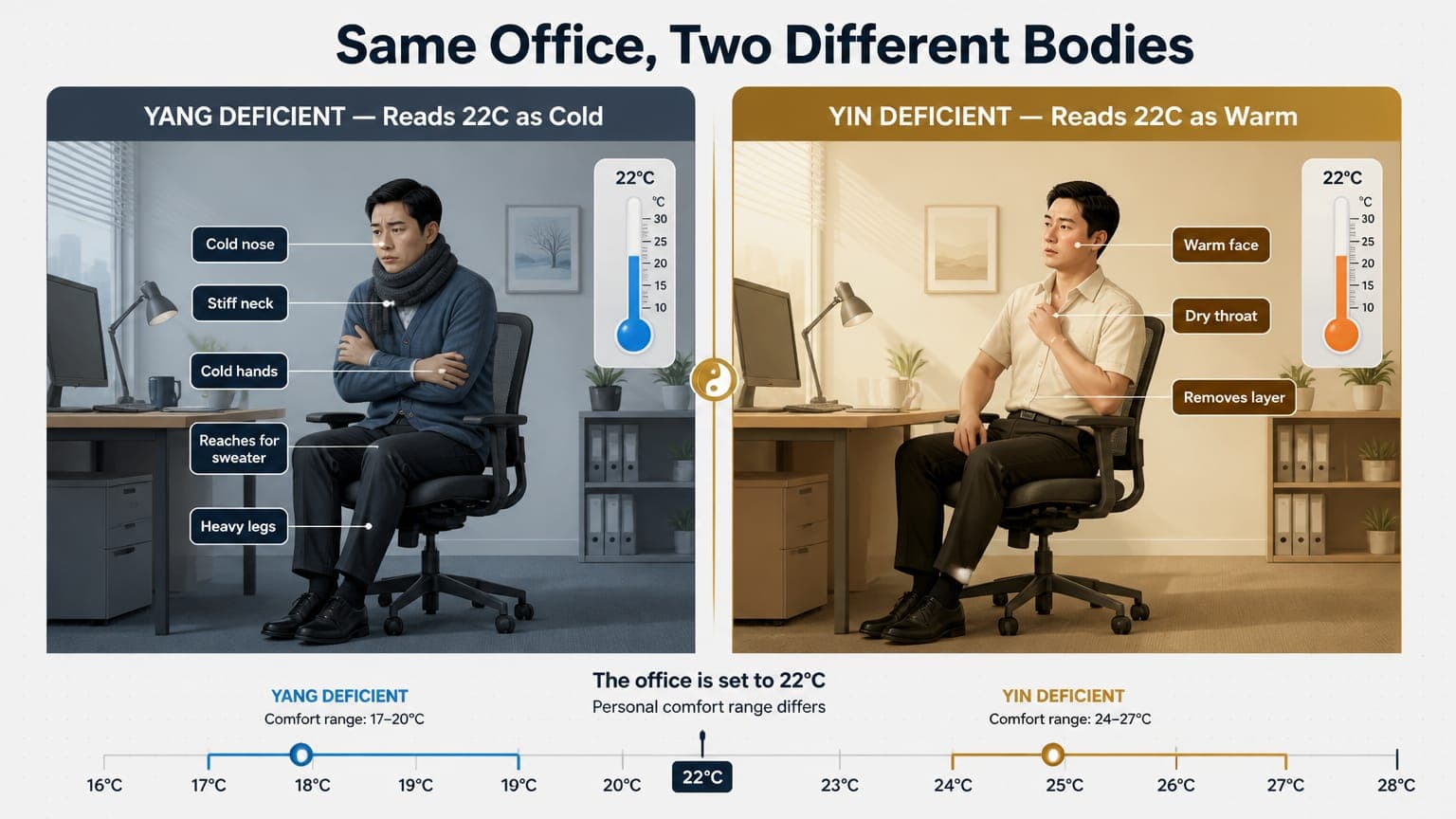
Side-by-side infographic showing how Yang Deficient and Yin Deficient office workers experience the same 22C temperature differently

Nine Body Types, Nine Thermostat Preferences

Body TypeComfortable RangeReaction to Standard 22C OfficeEarly Signal
Yang Deficient25 to 28CCold hands, cold face, shivering within an hourReaches for a sweater or scarf
Qi Deficient24 to 26CDrowsy, heavy limbs, winded by minor tasksYawns repeatedly after lunch
Yin Deficient20 to 22CWarm face, dry throat, restless by mid-afternoonRemoves a layer, opens a collar
Damp Heat20 to 23CSticky skin, irritability, skin flare-upsWipes forehead, sighs heavily
Phlegm Damp23 to 25CHeavy head, groggy, nasal congestionClears throat often, looks puffy
Qi Stagnant22 to 24C (varies with mood)Tension in shoulders, short temper, sighingSnaps at small interruptions
Blood Stasis23 to 25CCold hands and feet despite a warm trunkRubs hands together, stretches wrists
Sensitive22 to 24C (with stable air flow)Sneezing, dry eyes, headaches from cold draftsReaches for tissues, blinks often
Balanced21 to 25CComfortable across the full rangeDoes not complain, rarely adjusts

Office Air-Con Survival Map

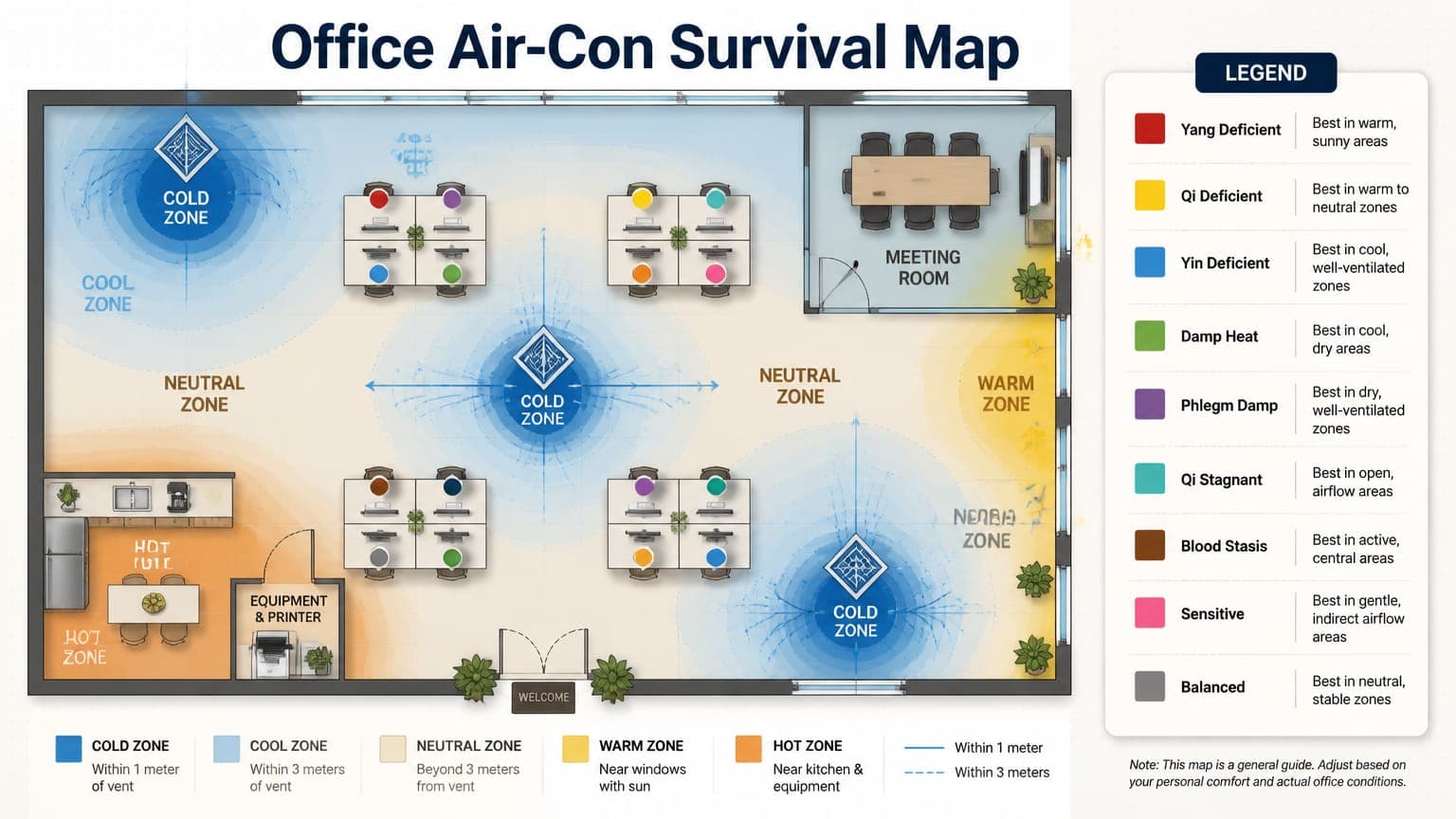
Diagram of an office floor plan showing air flow patterns and the best seats for each body type

If you want to know which of the nine body types you are before reading further, the free 5-minute quiz will tell you. The result comes with workplace-related notes for your specific constitution, so the parts of the office that will cost you the most energy are not a surprise.

Take the Free Quiz

Where You Sit Changes Everything

Before talking about clothing, tea, or thermostat negotiation, the single most underrated lever in office comfort is the seat itself. In most air-conditioned offices, the temperature at any given point can vary by three to five degrees from the temperature on the thermostat. The thermostat measures one location. The people sitting under a vent are living in a different climate. The coldest spots in a typical office are directly under or beside the air-conditioning vents, and within about two meters of the unit. Air at the vent is moving fast and is often below the setpoint temperature, because the sensor is somewhere else. A Yang Deficient or Qi Deficient person sitting in this zone will be miserable within the hour, no matter how many layers they add. The warmest spots are usually along interior walls away from vents, near windows that get afternoon sun, and around clusters of people or equipment that generate heat. A Yin Deficient or Damp Heat person does better in the cooler zones, and may actively prefer the vent-adjacent seats that others avoid. If you have any flexibility over your seat, choose based on your constitution first and your team proximity second. A desk move is often a more effective fix than any amount of clothing or complaint. A Qi Stagnant person, who tends to be sensitive to drafts and temperature swings, benefits most from a stable corner away from vents and doors. A Sensitive person, who reacts to dust and air dryness as much as to temperature, should sit as far from the vent as possible while still getting fresh air return.

The Layering Strategy: What to Keep at Your Desk

  • Yang Deficient: A thin wool cardigan in a neutral color, and a large soft scarf that can double as a shoulder wrap. Keep both at the desk permanently.
  • Qi Deficient: A thin vest that warms the core without restricting movement, and woolen socks to swap in when feet go cold.
  • Yin Deficient: A breathable cotton layer you can remove without disruption, and a small bottle of throat-moistening syrup or honey water.
  • Damp Heat: Loose natural-fiber clothing only, and a small pack of oil-blotting sheets. Avoid synthetic layers, which trap heat.
  • Phlegm Damp: Loose comfortable clothing that does not bind at the waist, and a thin layer you can add if the head feels heavy.
  • Qi Stagnant: Comfortable clothing that does not constrict the ribcage or waist. Tight layers worsen the tendency toward frustration.
  • Blood Stasis: Compression socks for under the desk, and fingerless gloves that keep the hands warm while leaving fingers free to type.
  • Sensitive: A silk or cotton face mask for dusty days, eye drops, and a thin layer you can add or remove as the air shifts.
  • Balanced: One light layer kept at the desk for unexpected changes. The basics are usually enough.

How to Negotiate the Thermostat Without Starting a War

Most thermostat conversations fail because they are framed as a battle with a winner and a loser. Raise the temperature and one colleague boils. Lower it and another reaches for a blanket. The pattern repeats because the underlying problem, that one temperature cannot suit nine body types, is never named. The steps below are not about getting your way. They are about getting a workable compromise without souring the working relationship.

  1. 1

    Lead with the body, not the complaint

    Open with a specific observation about yourself rather than a demand about the thermostat. Saying "I run cold and my hands go stiff around 3 PM" lands very differently than "It is freezing in here, can someone fix the AC." The first invites help, the second picks a fight.

  2. 2

    Bring one specific, small request

    Vague complaints produce vague responses. Bring a single actionable request. "Could we try 24 degrees for a week and see how it feels" is workable. "The temperature is always wrong" is not.

  3. 3

    Propose a layering-first solution

    Offer to add a layer yourself before asking others to change the setting. "I will keep a sweater here, and if I am still cold by Thursday, could we nudge it up one degree" is almost impossible to refuse and almost always effective.

  4. 4

    Find your allies before raising it in a group

    If you run cold, two other people in the office probably do too. Ask around privately first. A request from three people is a preference. A request from one person is a complaint. The same applies to running hot.

  5. 5

    Address the air flow, not just the number

    Often the problem is not the setpoint but the vent direction. Asking facilities to redirect a vent or install a deflector is usually easier than changing the temperature, because it does not require everyone to agree on a new number.

  6. 6

    Escalate to equipment only if all else fails

    Personal desk heaters, small USB fans, and heated mouse pads exist for a reason. They are the last resort, not the first, because they signal that the shared conversation has failed. Use them when nothing else works, not as a substitute for the conversation.

Office Tea by Body Type

Body TypeRecommendedLimitBest Time
Yang DeficientGinger tea with brown sugarIced water, iced coffeeMid-morning, 10 to 11 AM
Qi DeficientJujube date tea, lightly sweetenedStrong coffee, energy drinksMid-morning, replaces second coffee
Yin DeficientChrysanthemum tea, lightly honeyedBlack coffee, spicy teasAfternoon, 2 to 4 PM
Damp HeatGreen tea, unsweetenedSweet drinks, alcohol at lunchMorning, before 11 AM
Phlegm DampAged tangerine peel tea (chen pi)Dairy drinks, sweet milk teaAfter meals
Qi StagnantRose tea, or rose and chrysanthemum blendCaffeine-heavy drinksMid-afternoon, 3 to 4 PM
Blood StasisRose tea with a few goji berriesCold drinks, especially on arrivalMorning and late afternoon
SensitiveWarm water with a thin slice of gingerStrongly scented or caffeinated teasThroughout the day, small sips
BalancedAny warm tea you enjoyExcessive iced drinksAny time

Three Office Personalities You Will Recognize

By this point the pattern should be clear. There is no such thing as a correct office temperature, only a temperature that suits the loudest or most powerful person in the room. The three office personalities below are not exaggerations. If you have spent any time in a shared workspace, you have met all three.

Three Office Personalities, One Shared Office
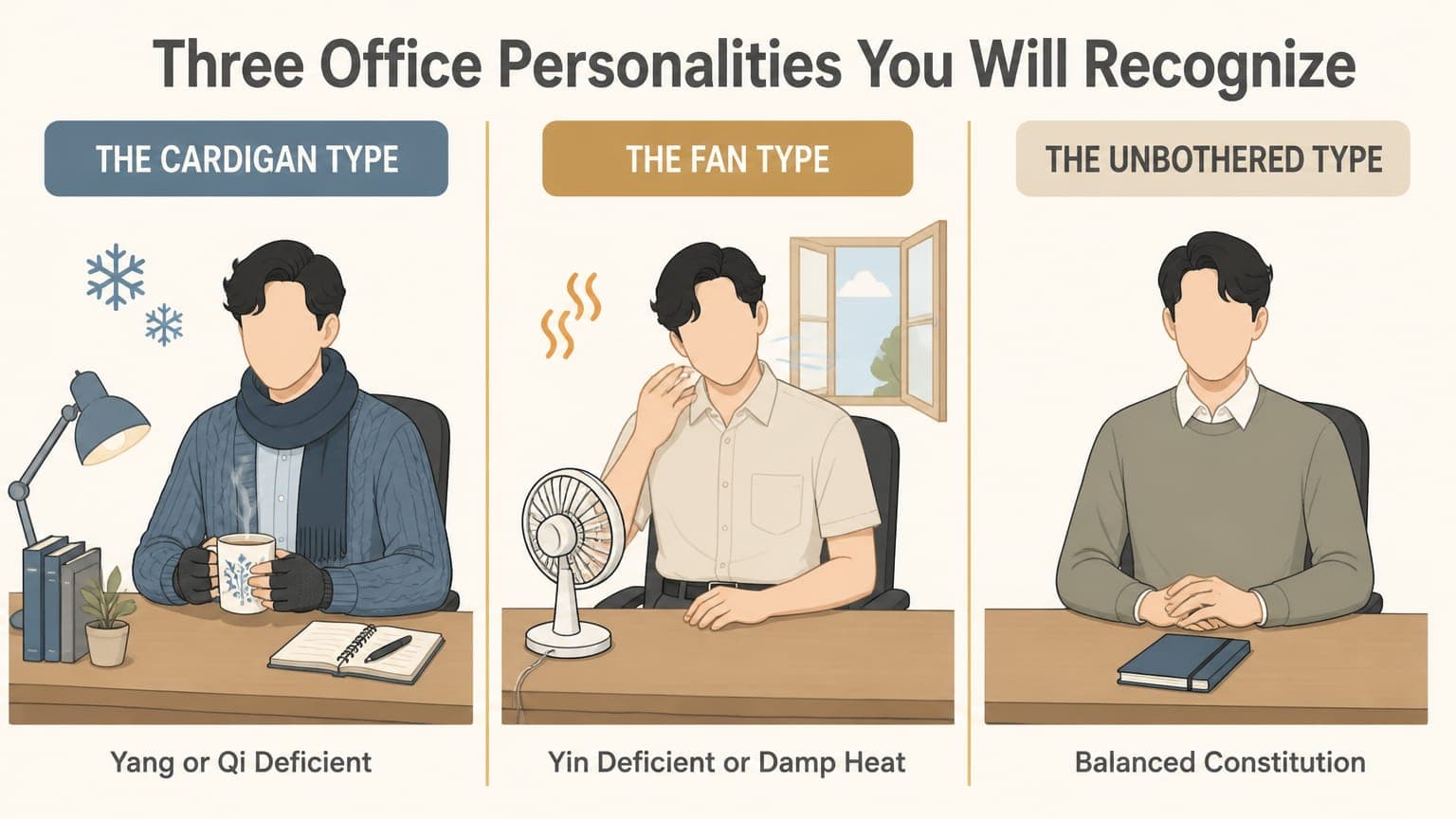
Three office personality types shown side by side with their characteristic desk items

The Colleague Who Always Has a Sweater

This is the Yang Deficient or Qi Deficient office worker. They have a cardigan draped over their chair, a thin scarf in their bag, and a quiet dislike of the air-conditioning vent above their desk. They are often the first to arrive and the first to feel the cold that builds through the morning. By 3 PM they are wrapped in three layers and still rubbing their hands together. Their mistake is usually not speaking up early enough. The cold accumulates, and by the time they mention it, they are already irritable and the conversation comes out wrong. The fix is to raise it on day one, ideally before the temperature becomes a personal grievance, and to keep a written layering strategy at the desk rather than improvising.

The One Who Keeps a Fan at Their Desk

This is the Yin Deficient or Damp Heat worker. They have a small USB fan, a desk that is permanently clear of clutter so air can circulate, and a habit of opening windows that others have quietly closed. They feel the office as warm when everyone else feels it as neutral, and the gap widens through the afternoon. Their mistake is assuming everyone shares their experience. The fan that cools them is the same fan that chills the person one desk over. The fix is to direct the fan carefully, to vent the warm air rather than blowing cold air onto a neighbor, and to accept that a personal fan is a better answer than a thermostat battle.

The Lucky Type Who Never Notices

This is the Balanced office worker. They wear the same layer all day, drink whatever is closest, and genuinely do not understand what the rest of the team is arguing about. They are the closest thing the office has to a thermostat neutral, and for that reason they often end up in charge of the dial. Their blind spot is assuming the rest of the office is like them. It is not. A Balanced person setting the temperature for the team will almost always set it to their own preference, which by definition is wrong for everyone whose constitution runs hotter or colder. The fix is to delegate the dial to the most temperature-sensitive person on the team, not the least.

There Is No Standard Temperature

The office thermostat war is one of those problems that looks like a personality clash and is actually a physiology clash. Nine body types sharing one dial are bound to disagree, because the dial is calibrated for an average person who does not exist. The way out is not to find the right number. It is to accept that the number will be wrong for someone, and to give that someone the tools, the clothing, the tea, the seat, and the language to make a shared space livable without making it a battleground. If your office has a chronic temperature war, that is information. It tells you that the team is constitutionally diverse, which is healthy, and that the workspace has not yet caught up to that diversity, which is fixable. The next conversation about the thermostat does not have to be a fight. It can be the first time the underlying problem gets named out loud.

Related Articles

Frequently Asked Questions

Why is my office always cold even when the thermostat reads 22 degrees?+
The thermostat measures the temperature at one location, usually on a wall away from vents and people. The actual temperature at your desk can be three to five degrees lower, especially if you sit near an air-conditioning vent. Body type also plays a role. A Yang Deficient person will feel 22 degrees as cold, while a Yin Deficient person at the same desk will feel it as comfortable.
What temperature should the office be set to?+
There is no single correct number. The commonly cited 22 to 24 degrees Celsius is a compromise that suits no constitution perfectly. A more practical approach is to set the office around 23 to 24 degrees, which is tolerable for most types, and to let individuals adjust through clothing, tea, and desk position rather than fighting over the dial.
Which body type struggles most with air conditioning?+
Yang Deficient and Qi Deficient types feel air-conditioned offices most acutely, because their internal warming system is already running low. Yin Deficient and Damp Heat types tend to prefer cooler settings and rarely complain. A body type quiz can help you identify your own pattern.
Is it bad to sit directly under an air-conditioning vent?+
For most body types, yes. The air at the vent is colder and faster-moving than the rest of the office. Yang Deficient, Qi Deficient, and Sensitive types should avoid vent-adjacent seats. Yin Deficient types often actively prefer them.
Does drinking warm drinks actually help with office cold?+
Yes, modestly but noticeably. Warm drinks support the Spleen in Chinese medicine and gently raise core temperature. Ginger tea, jujube date tea, and warm water with a thin slice of ginger are traditional options for cold-type constitutions. Iced drinks have the opposite effect and tend to make cold-type office workers feel worse.
How do I raise the office temperature without annoying my colleagues?+
Lead with a personal observation rather than a complaint, bring one specific request, offer to layer up yourself first, and find allies before raising it in a group. The full six-step approach is covered earlier in this guide.

Discover Your Eastern Type

Take our free 5-minute assessment to explore which body type best matches your current wellness patterns.

Take the Free Quiz

This article is for informational and educational purposes only and is not medical advice. Always consult a qualified healthcare professional for medical concerns.

EastType
10 Foods Your Body Type Will Love
A Practical Chinese Medicine Guide
Chinese medicine identifies 9 body types. Each type has foods that suit it well. This guide covers 10 ingredients used in Chinese medicine traditions for centuries.
myeasterntype.com
1
Ginger
Also known as: Sheng Jiang (Chinese), Shoga (Japanese), Adrak (Hindi), Khing (Thai)

Ginger is the most widely used warming food in Chinese medicine. If your hands and feet tend to run cold, or if you feel heavy and slow after meals, ginger may be one of the simplest things you can add to your daily routine.

Who It Suits

Cold Sensitivity and Low Vitality body types (people who tend to run cold, feel fatigued, or have slow digestion).

What It May Help With
Warming the body from the inside
Supporting digestion after heavy or cold meals
Reducing that heavy, sluggish feeling after eating
How to Use
Slice 3 to 4 thin pieces of fresh ginger and steep in hot water for 5 minutes. Drink this in the morning, 20 minutes before breakfast.
Add grated ginger to soups, stews, and stir-fries.
Avoid ginger late at night if you tend to feel hot when trying to sleep.
Simple HabitReplace your first glass of cold water in the morning with a cup of warm ginger water. This single change can make a noticeable difference in how your digestion feels throughout the day.
2
Goji Berries
Also known as: Wolfberries, Gou Qi Zi (Chinese), Kuko no Mi (Japanese), Boxthorn Berries

Goji berries are small, sweet, red dried fruits that look similar to raisins but have a distinct tart-sweet flavor. In Chinese medicine, they are associated with eye health, liver support, and healthy aging.

Who It Suits

Internal Heat body types (people who tend to feel warm at night, have dry skin, or wake up between 1 AM and 3 AM). Also suitable for people concerned about eye strain from screens.

What It May Help With
Supporting eye comfort during long screen hours
Nourishing the body's cooling and moistening functions
Providing a gentle energy source without caffeine
How to Use
Eat a small handful (about 15 to 20 berries) as a snack.
Add to oatmeal, yogurt, or trail mix.
Steep in hot water with chrysanthemum flowers for a gentle tea.
Simple HabitKeep a small jar of goji berries at your desk. Eat 10 to 15 berries around 3 PM, when afternoon energy dips tend to hit. They provide a mild, steady energy without the crash that comes with sugar or caffeine.
3
Red Dates (Jujube)
Also known as: Chinese Dates, Hong Zao (Chinese), Natsume (Japanese), Injeol (Korean)

Red dates are dried jujube fruits, not related to the Middle Eastern dates you find in most Western supermarkets. They are sweet, slightly chewy, and have been used in Chinese medicine for thousands of years to support calm sleep and steady energy.

Who It Suits

Low Vitality and Stuck Energy body types (people who feel chronically tired, anxious, or have trouble falling asleep).

What It May Help With
Supporting calm and restful sleep
Providing a gentle, steady source of energy
Settling an anxious or overactive mind
How to Use
Simmer 5 to 6 pitted red dates in water for 15 minutes. Drink the liquid as tea before bed.
Add to rice porridge (congee) for a nourishing breakfast.
Eat 2 to 3 dates as an afternoon snack.
Simple HabitBrew a small pot of red date tea in the evening. Let it steep while you wind down, and drink it 30 minutes before bed. Many people notice calmer, more settled sleep within the first week.
4
Black Sesame Seeds
Also known as: Hei Zhi Ma (Chinese), Kuro Goma (Japanese), Gingili (Indian)

Black sesame seeds look like tiny dark pearls and have a rich, nutty, slightly smoky flavor. In Chinese medicine, their dark color connects them to the body's deepest energy reserves. They are associated with healthy hair, skin, and the body's foundational vitality.

Who It Suits

Internal Heat and Blood Stasis body types (people concerned about hair thinning, dry skin, premature aging, or dark circles under the eyes).

What It May Help With
Supporting hair strength and skin moisture
Nourishing the body's deepest energy reserves
Providing healthy fats and minerals
How to Use
Grind 2 tablespoons of black sesame seeds and mix with a small amount of honey. Eat one spoonful each morning.
Sprinkle on rice, noodles, salads, or avocado toast.
Use black sesame paste (similar to tahini but made from black sesame) as a spread on toast.
Simple HabitBuy a small bag of pre-roasted black sesame seeds. Keep it next to your salt shaker. Sprinkle on everything savory. This is one of the easiest ingredients to integrate into Western meals.
5
Mung Beans
Also known as: Lu Dou (Chinese), Ryokuto (Japanese), Moong Dal (Hindi), Green Gram (English)

Mung beans are small, green legumes that cook quickly and have a mild, slightly sweet flavor. In Chinese medicine, they are considered one of the most cooling foods available. They are traditionally eaten during hot summer months to help the body manage internal heat.

Who It Suits

Damp Heat body types (people who tend to feel hot and sticky, have oily skin, breakouts, or acid reflux). Also suitable for anyone during hot weather.

What It May Help With
Supporting the body's natural cooling processes
Helping the body process and eliminate excess fluids
Soothing skin inflammation from the inside
How to Use
Simmer 1 cup of mung beans in 4 cups of water for 30 minutes until soft. Add a little rock sugar for a simple sweet soup.
Sprout mung beans at home for fresh, crunchy bean sprouts (takes 2 to 3 days in a jar).
Cook mung bean soup once a week during summer months.
Simple HabitDuring hot weather, replace one meal per week with a simple bowl of mung bean soup. It is light, cooling, and easy to digest. People who tend to break out in summer often notice their skin calms down within 2 to 3 weeks of eating mung beans regularly.
6
Walnuts
Also known as: He Tao (Chinese), Kurumi (Japanese), Akhrot (Hindi), Nuez (Spanish)

Walnuts look like tiny brains, and in Chinese medicine, this visual resemblance is taken seriously. Walnuts are associated with brain function, memory, and the body's deepest warmth reserves. They are also one of the most accessible ingredients on this list.

Who It Suits

Cold Sensitivity and Internal Heat body types concerned about memory, focus, or lower back discomfort. Also suitable for older adults.

What It May Help With
Supporting memory and mental clarity
Warming and strengthening the lower back and knees
Providing omega-3 fatty acids
How to Use
Eat 5 to 8 walnuts per day as a snack. Chew thoroughly.
Add chopped walnuts to oatmeal or yogurt.
Simmer walnuts in porridge with red dates for a nourishing breakfast.
Simple HabitKeep a small container of walnuts where you work. Eat 5 pieces at 10 AM and 5 pieces at 3 PM. The steady supply of healthy fats supports focus and sustained energy without the spike-and-crash of sugary snacks.
7
Chinese Yam
Also known as: Shan Yao (Chinese), Nagaimo (Japanese), Ma (Korean), Mexican Yam

Chinese yam is a long, cylindrical root with a pale interior. When raw, it feels slippery and slightly sticky when cut. When cooked, it becomes tender and mildly sweet. In Chinese medicine, it is one of the most recommended foods for people with sensitive digestion.

Who It Suits

Heavy and Sluggish body types (people who bloat after meals, feel heavy and tired, or have irregular digestion). Also suitable for anyone recovering from illness.

What It May Help With
Strengthening digestive function over time
Supporting steady, consistent energy levels
Reducing bloating and heaviness after meals
How to Use
Peel, slice, and stir-fry with a little salt and sesame oil for a simple side dish.
Cut into chunks and add to soups or stews.
Slice thinly and steam for 15 minutes. Drizzle with a little honey.
Simple HabitIf you have a sensitive stomach that reacts to raw vegetables, try replacing raw salads with steamed Chinese yam twice a week. Its gentle, starchy nature gives your digestive system a break while still providing nutrients.
8
Chrysanthemum Flowers
Also known as: Ju Hua (Chinese), Kikka (Japanese), Gul-e-Daudi (Hindi)

Dried chrysanthemum flowers are brewed into a light, floral tea that has been consumed in East Asia for centuries. The tea is golden-colored, delicate in flavor, and naturally caffeine-free. In Chinese medicine, chrysanthemum is associated with cooling internal heat, especially in the head and eyes.

Who It Suits

Internal Heat and Stuck Energy body types (people who get headaches, eye strain, feel hot and irritable, or have trouble sleeping). Also ideal for office workers who stare at screens all day.

What It May Help With
Soothing tired, dry, or strained eyes
Cooling the head and reducing tension headaches
Supporting calm focus without caffeine
How to Use
Steep 8 to 10 dried chrysanthemum flowers in hot water for 5 minutes. Drink as is or add a few goji berries.
Drink in the afternoon instead of coffee or green tea.
Can be enjoyed cold in summer with a touch of honey.
Simple HabitReplace your afternoon coffee with chrysanthemum tea for one week. Many people notice their afternoon energy feels more stable and their eyes feel less strained by the end of the workday. You can find dried chrysanthemum flowers at most Asian grocery stores or online.
9
Longan
Also known as: Dragon's Eye, Gui Yuan (Chinese), Ryugan (Japanese), Lamyai (Thai)

Dried longan is a small, round, dark brown fruit that looks like a tiny pearl when shelled. It gets its English name, "Dragon's Eye," from the fresh fruit, which has a dark seed visible through the translucent white flesh. Dried longan is sweet, warm in nature, and has been used in Chinese medicine to support calm energy and restful sleep.

Who It Suits

Low Vitality body types (people who feel chronically tired, anxious, or have trouble sleeping due to an overactive mind).

What It May Help With
Supporting calm, settled energy during the day
Helping quiet an overactive mind at night
Providing a gentle, non-stimulating source of sweetness
How to Use
Simmer 10 to 15 dried longan in water for 10 minutes. Drink the tea before bed.
Add to rice porridge along with red dates for a nourishing breakfast.
Eat 5 to 6 pieces as a sweet snack.
Simple HabitIf you tend to snack on sweets in the evening, replace candy or chocolate with 8 to 10 dried longan pieces. They satisfy the sweet craving while supporting calm, restful sleep.
10
Lotus Seeds
Also known as: Lian Zi (Chinese), Hasu no Mi (Japanese), Bikh (Hindi)

Lotus seeds are small, ivory-colored seeds harvested from the seed pod of the lotus flower. They have a mild, slightly sweet, and slightly nutty flavor. In Chinese medicine, they are associated with calm, steady energy and clear thinking. They are one of the key ingredients in traditional East Asian desserts and savory dishes alike.

Who It Suits

Stuck Energy and Heavy and Sluggish body types (people who overthink, feel mentally scattered, or have trouble concentrating).

What It May Help With
Supporting mental calm and clear focus
Helping settle an overactive, racing mind
Supporting steady, even-keeled energy
How to Use
Soak dried lotus seeds overnight, then simmer in water for 30 minutes until tender. Add rock sugar for a simple sweet soup.
Add cooked lotus seeds to soups and stews.
Find canned lotus seeds at Asian grocery stores for convenience.
Simple HabitIf your mind races at night and prevents you from sleeping, try a small bowl of lotus seed soup as an evening snack. Its calming quality may help quiet mental chatter and support more settled sleep.
How to Start

You do not need to buy all 10 ingredients today. Here is a simple way to begin:

1Take the EastType quiz to learn your body type.
2Pick 2 ingredients from this guide that suit your type.
3Start with one habit from the "Simple Habit" section of each food.
4Give it 2 to 3 weeks. Notice how your body responds.
5Adjust from there. Chinese medicine is about consistent, small adjustments, not dramatic overhauls.
Where to Find These Ingredients
Asian grocery stores (look for H Mart, 99 Ranch, Mitsuwa, or local equivalents)
Online (Amazon, iHerb, Asian food specialty sites)
Health food stores (ginger, walnuts, and goji berries are widely available)
Regular supermarkets (ginger, walnuts, and mung beans are usually in stock)

Most of these ingredients cost between $3 and $10 and last for weeks or months. Chinese medicine eating does not need to be expensive.

A Final Note

This guide is for educational and wellness purposes only. It is not medical advice. If you have specific health concerns, food allergies, or are taking medication, consult a qualified healthcare provider before making dietary changes.

Individual responses to foods vary. The information in this guide reflects traditional Chinese medicine principles, which focus on patterns and tendencies rather than medical diagnoses.

Listen to your body. Start small. Be consistent. That is the Chinese medicine way.
Ready to Find Your Body Type?
Take the free 5-minute quiz and get personalized food suggestions tailored to your constitution.
myeasterntype.com