Heatwave Survival: How Your Body Type Decides How You Handle Extreme Heat
A 40 degree day feels different depending on your constitution. Here is how each of the nine body types handles a heatwave, and what may help you stay balanced.
Why Heat Hits Different Bodies Differently
When the temperature hits 40 degrees and the air feels like it is pressing down on your skin, everyone suffers. But not everyone suffers the same way. You probably know someone who seems unbothered by heat that makes you feel sick, or someone who starts sweating the moment the mercury climbs past 30. In Chinese medicine, this difference has a name: heat intolerance, and it is shaped by your body type, what TCM calls your constitution. A person running warm internally may feel summer heat as unbearable. Someone who runs cold might actually feel energized. Understanding your type may help you choose the right foods, habits, and precautions when the next heatwave arrives.
Curious which body type you are? Take the free 5-minute quiz.
Take the Free Quiz →The Nine Body Types in a Heatwave
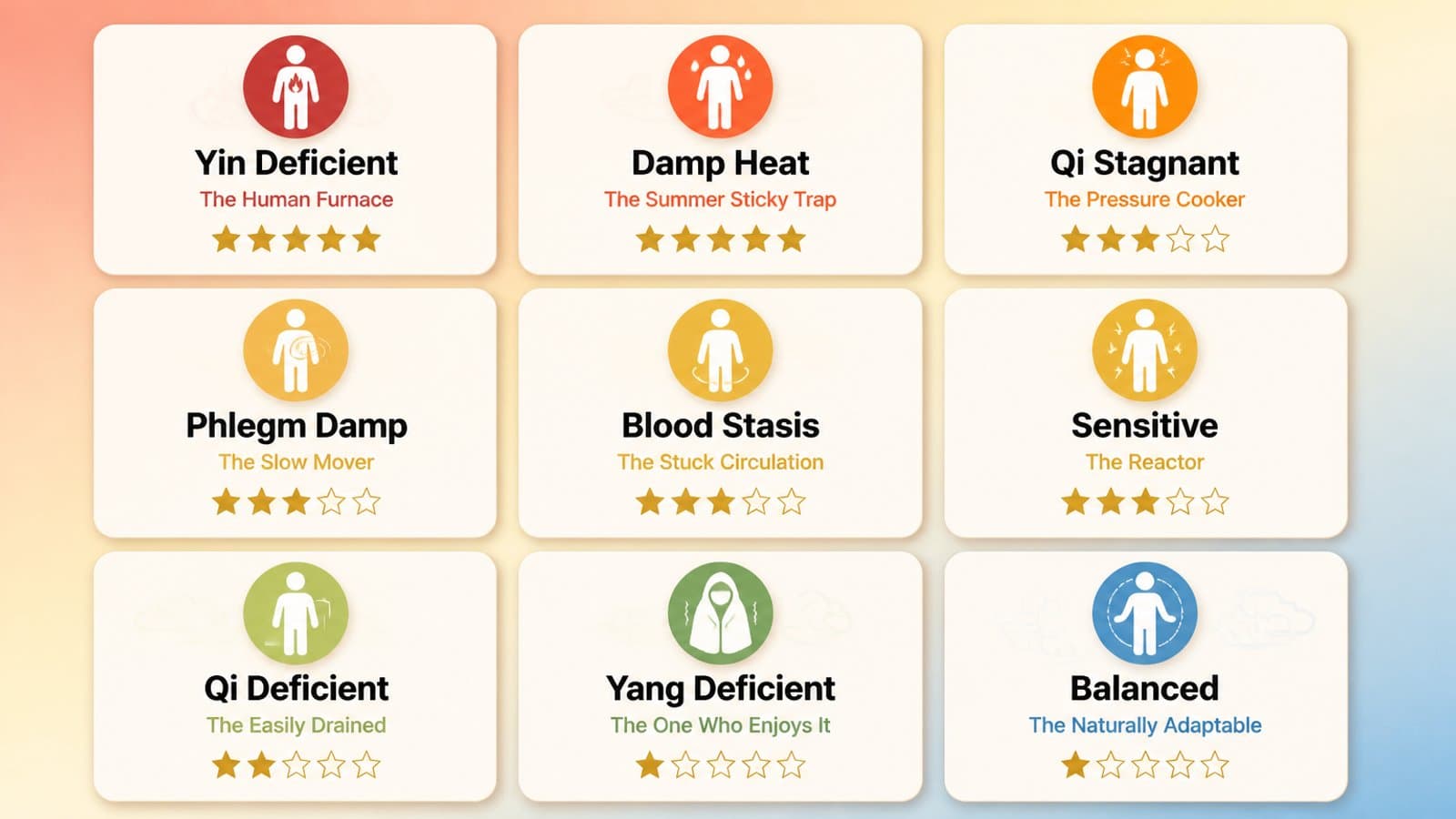
The Nine Body Types in a Heatwave
| Body Type | Heat Tolerance | How It Feels | Heat Risk |
|---|---|---|---|
| Yin Deficient | Very Low | Internal heat compounds with external heat; night sweats worsen | ★★★★★ |
| Damp Heat | Low | Heat plus humidity feels sticky, heavy, and suffocating | ★★★★★ |
| Qi Stagnant | Moderate | Heat worsens frustration, tension, and irritability | ★★★☆☆ |
| Phlegm Damp | Moderate | Feels sluggish and congested; sweating brings little relief | ★★★☆☆ |
| Blood Stasis | Moderate | Heat may worsen circulation discomfort and pain patterns | ★★★☆☆ |
| Sensitive | Moderate | Heat can trigger reactive skin or breathing responses | ★★★☆☆ |
| Qi Deficient | Moderate to High | Heat drains energy and breath but not unbearable | ★★☆☆☆ |
| Yang Deficient | High | May feel comfortable or even energized by the warmth | ★☆☆☆☆ |
| Balanced | High | Adapts well with basic hydration and shade | ★☆☆☆☆ |
Heat Tolerance by Body Type: The Full Spectrum
Across the nine body types, nearly two-thirds face moderate to high risk during a heatwave. Only two types, Yang Deficient and Balanced, handle extreme heat with relative ease. In TCM theory, Yin Deficient types have the lowest heat tolerance of all nine constitutions, because their bodies already run warm before the heatwave even begins.
Want to know which of the nine body types you are? Take the free 5-minute quiz and find out how your constitution may shape your experience with heat, cold, and everything in between.
Take the Free Quiz →The High-Risk Types
Two body types account for most heatwave suffering. If you belong to either, a heatwave is not just uncomfortable. It is a signal to slow down, adjust your diet, and pay attention to what your body is telling you.
Yin Deficient: The Human Furnace
Yin Deficient types are the people most likely to suffer in a heatwave. If you wake up at 3 AM drenched in sweat, if your throat feels dry no matter how much water you drink, and if the mere thought of a hot summer night makes you dread bedtime, you may well belong to this group. Their bodies already run warm due to a lack of cooling, moistening energy, making them the most heat-intolerant of all nine constitutions. When external heat adds to this internal fire, the result can be intense. Night sweats worsen. Hot flashes become more frequent. Sleep, already fragile for many Yin Deficient types, may become impossible during hot nights. In severe cases, the combination of internal and external heat may produce signs associated with heat exhaustion, including dizziness, nausea, and profound fatigue. What may help: cooling, moistening foods like pear, watermelon, mung bean soup, and lily bulb. Avoid spicy food, alcohol, and late nights.
Damp Heat: The Summer Sticky Trap
Damp Heat types face a double burden in summer: heat plus humidity. If your skin breaks out the moment the weather turns hot and sticky, if you feel irritable and heavy for no clear reason, and if your body feels like it is wrapped in a hot, damp cloth that will not come off, this may be your pattern. The heatwave does not just feel hot. It feels suffocating. Urine may become dark and concentrated. What may help: foods that clear heat and drain dampness, like winter melon, coix seed, and green tea. Avoid heavy, greasy, or sweet foods that add more dampness.
The Low-Risk Types
Some people barely notice a heatwave. If you are one of them, you are probably Yang Deficient or Balanced. But low risk does not mean no risk. Even comfortable types need to stay hydrated and avoid overexertion, because the body loses fluids in heat regardless of how it feels.
Yang Deficient: The One Who Enjoys It
Yang Deficient types are the rare people who actually enjoy a heatwave. Their bodies run cold due to a lack of warming, activating energy. External heat provides a temporary balance to this internal cold. They may feel more energetic, more comfortable, and less bothered by temperatures that make others miserable. However, they should still stay hydrated and avoid overexertion, because the body still loses fluids in heat regardless of how it feels.
Balanced: The Naturally Adaptable
Balanced types adapt well to heat, assuming they take basic precautions. Their internal temperature regulation works as it should. They may feel uncomfortable in extreme heat but are unlikely to experience severe symptoms. Staying hydrated, eating light meals, and avoiding the midday sun are usually sufficient.
How to Cool Down: Universal Rules for Every Body Type
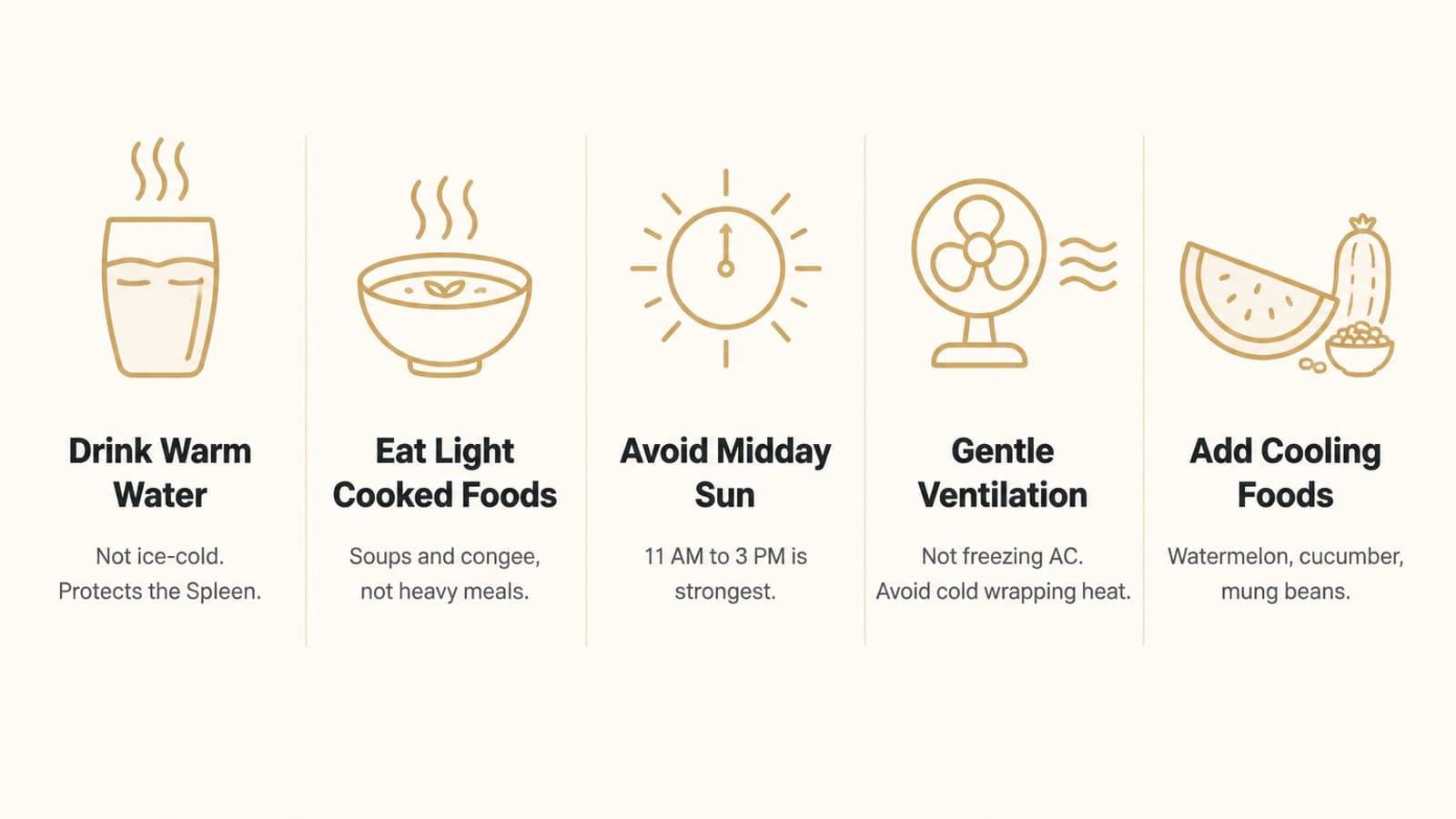
Universal Heatwave Rules
- •Drink warm, not ice-cold, water. Chinese medicine considers ice-cold drinks harmful to the Spleen and Stomach, even in heat. Warm water hydrates without shocking the digestive system.
- •Eat light, cooked foods. Heavy meals generate more internal heat during digestion. Soups, congee, and steamed vegetables are easier on the body when it is already working hard to stay cool.
- •Avoid the midday sun. Between 11 AM and 3 PM, the sun is strongest. If you must go out, cover your head and neck.
- •Sleep with ventilation, not freezing air conditioning. Direct cold air on a sweating body can trap heat inside, a concept TCM calls cold wrapping heat.
- •Add cooling foods to your daily meals. Watermelon, cucumber, mung beans, and lotus root are traditional summer foods for a reason.
How to Make Mung Bean Soup: A Step-by-Step Cooling Recipe
Mung bean soup is arguably the most iconic of all Chinese cooling drinks, a staple in households across East Asia during the summer months. When brewed correctly, the soup stays clear and greenish-yellow, which is when its cooling effect is strongest. Overcooking turns it brown and sweet, making it a dessert but reducing its heat-clearing quality. Here is how to make it the traditional way.
- 1
Pick the right beans
Choose mung beans that are plump, bright green, and uniform in size. Avoid beans that look dull, dark, or have tiny holes from insects. The color of the bean directly affects the color and cooling quality of the finished soup.
- 2
Soak before cooking
Rinse the beans thoroughly under running water, then soak them in cold water for 2 to 3 hours. If you are short on time, hot water for 30 minutes works too. Soaking helps the beans cook evenly and release their cooling properties more fully.
- 3
Use the right ratio and pot
One part mung beans to ten parts water is the traditional ratio. For a single serving, that is roughly 50 grams of beans to 500 milliliters of water. Use a clay pot or stainless steel pot. Avoid iron, because iron reacts with the beans and turns the soup dark.
- 4
Bring to a boil on high heat
Put the soaked beans and fresh water in the pot and bring to a rolling boil over high heat. This initial burst of heat helps crack the bean skins open so the cooling essence can release into the water.
- 5
Simmer on low heat for 15 to 20 minutes
Once boiling, reduce to a low simmer and cook for 15 to 20 minutes. The goal is for the beans to just begin splitting open, not to cook them into a paste. If you overcook, the soup turns reddish-brown and loses much of its cooling effect. This is the most common mistake people make.
- 6
Stop while the soup is still green
The ideal mung bean soup is clear and yellowish-green. This is the stage where the cooling properties are strongest. If you prefer a sweeter, softer dessert-style soup, you can cook longer, but for heatwave cooling purposes, stop here and strain the liquid.
- 7
Add rock sugar to taste
Add a small amount of rock sugar and stir until dissolved. Rock sugar is preferred in TCM because it gently moistens the lungs and supports fluid production. Avoid brown sugar, which is warming in nature and may counteract the cooling effect of the mung beans. Let the soup cool to room temperature or chill briefly in the fridge before drinking.
- 8
Drink the right amount
One to two small bowls per day is plenty during a heatwave. Do not drink it ice-cold. Room temperature or slightly warm is best, consistent with the TCM principle of avoiding ice-cold drinks even in summer.
A Few Things to Keep in Mind About Mung Bean Soup
- •Do not drink on an empty stomach. Mung beans are cooling by nature. On an empty stomach, they may cause discomfort, especially if you have a weak Spleen or tend toward loose stools.
- •If you run cold, add ginger. If you have a Yang Deficient constitution, mung bean soup may be too cooling for you. A thin slice of fresh ginger added during cooking can help balance the coldness.
- •The leftover beans are edible. Do not throw away the cooked beans. They can be eaten as a snack, mashed into a paste, or added to rice porridge the next morning.
- •Drink it the same day. Mung bean soup loses its cooling quality after sitting overnight. Make a fresh batch each day during a heatwave rather than storing large quantities.
Heatwave Mistakes to Avoid
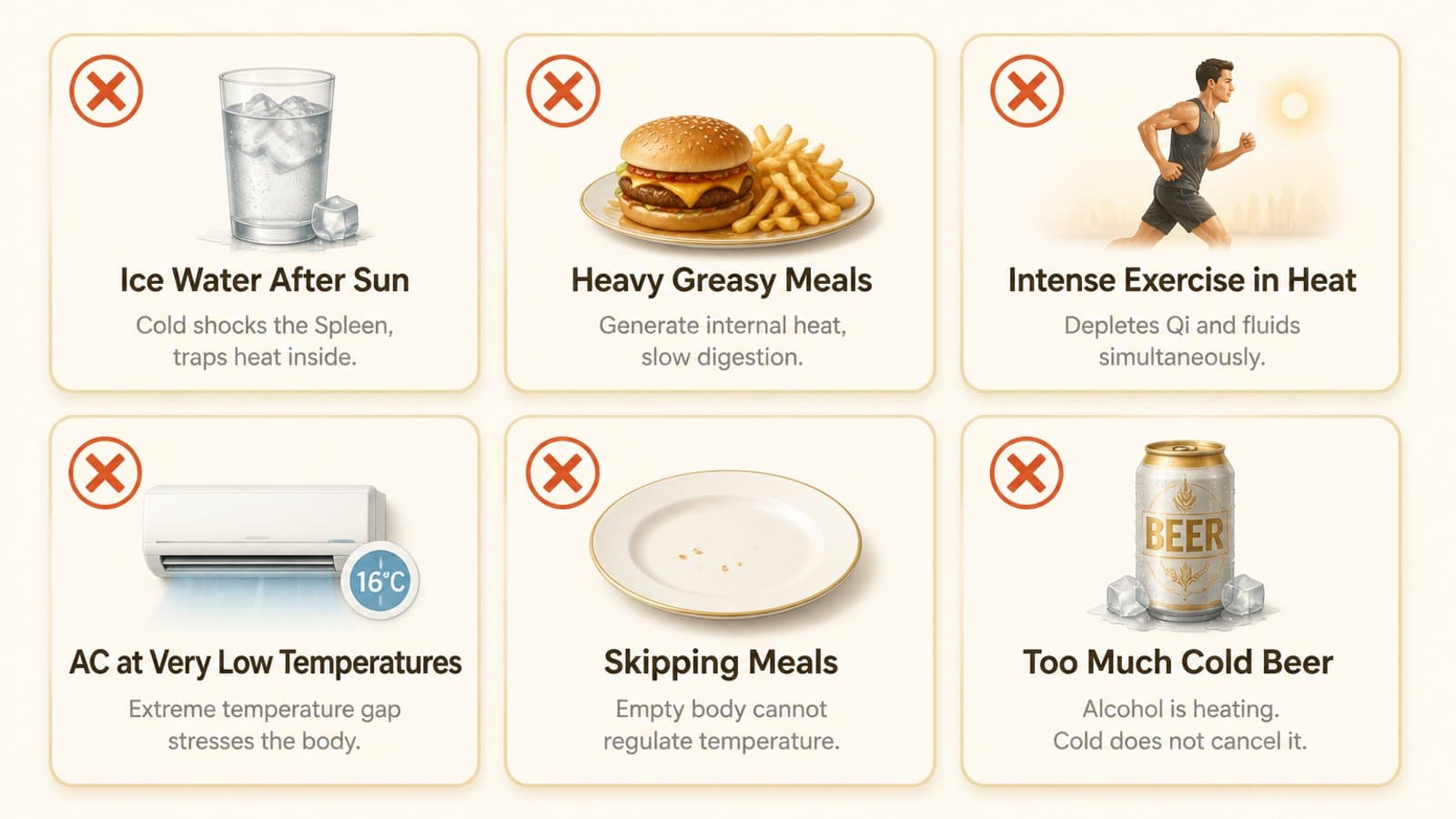
Heatwave Mistakes to Avoid
- •Drinking ice water after sun exposure. The cold shocks the Spleen and may trap heat inside the body.
- •Eating heavy, greasy meals. These generate internal heat and slow digestion when the body is already stressed.
- •Exercising intensely in the heat. This depletes Qi and fluids at the same time, leaving the body doubly drained.
- •Using air conditioning at very low temperatures. The extreme temperature gap between outside and inside stresses the body's regulation.
- •Skipping meals. Heat suppresses appetite, but an empty body has fewer resources to regulate temperature.
- •Drinking too much cold beer. Alcohol is heating in TCM, and the cold temperature does not cancel that effect.
- •Standing in front of blasting AC while sweating heavily. The sudden cold on an open, sweating body can trap heat inside and trigger summer colds. TCM calls this cold wrapping heat, and it is one of the most common summer health traps.
Related Articles
Frequently Asked Questions
Which body type is most at risk during a heatwave?+
Why do I feel sick in the heat when others seem fine?+
Should I drink ice water to cool down?+
What foods help during a heatwave?+
Can air conditioning make heat intolerance worse?+
Why does heat make me irritable?+
Is it normal to lose my appetite in a heatwave?+
Discover Your Eastern Type
Take our free 5-minute assessment to explore which body type best matches your current wellness patterns.
Take the Free Quiz→This article is for informational and educational purposes only and is not medical advice. Always consult a qualified healthcare professional for medical concerns.