Coffee and Your Body Type: Why It Helps Some and Wrecks Others
Your coworker swears by coffee. You crash after one cup. Chinese medicine explains why the same caffeine hits different body types so differently.
Why Coffee Splits People Into Two Camps
Coffee affects people very differently depending on their body type, and Chinese medicine may explain why. For Yang Deficient constitutions, a small cup of coffee can be associated with a gentle lift in warming energy that feels steadier than it does for others. For Yin Deficient types, the same cup may intensify internal dryness, irritability, and afternoon crashes, because caffeine pulls on a system already running hot and low on cooling reserves. Qi Deficient types often get a short spike followed by deeper fatigue. There is no universally good or bad answer. How coffee interacts with your constitution, your caffeine sensitivity, and your current energy reserves may matter far more than the drink itself. The split is not subtle. Walk into any office and you will find two camps. One group drinks espresso at 4 PM and sleeps fine. The other group has half a latte at 9 AM and spends the afternoon with a racing heart, a dry mouth, and a vague sense that something is wrong. Western nutrition frames this as a difference in caffeine metabolism, a story about liver enzymes and genetic variants. Chinese medicine frames it as a difference in constitution, the baseline state of your internal climate. Both are describing the same phenomenon from different angles. The TCM view simply adds a useful next step: if you know your body type, you can predict whether coffee will help or harm you, and you can pick a drink that fits your system instead of fighting it.
Curious which body type you are? Take the free 5-minute quiz.
Take the Free Quiz →The Nine Body Types and Coffee
| Body Type | Coffee Effect | Why | Better Alternative |
|---|---|---|---|
| Yin Deficient | Wrecks it | Adds fire to a system already running hot and dry | Chrysanthemum or honeysuckle tea |
| Damp Heat | Worsens it | Heat compounds, acne and irritability tend to rise | Green tea with coix seed |
| Qi Stagnant | Mixed bag | Brief mood lift, then tighter tension returns | Rose or tangerine peel tea |
| Phlegm Damp | Sluggish response | Caffeine cannot cut through the heavy dampness | Pu-erh tea, warm ginger water |
| Blood Stasis | Mild effect | Little direct impact, but lost sleep worsens stasis | Rose tea with jujube dates |
| Sensitive | Overstimulates | Even small amounts cause palpitations and jitters | Rooibos or barley tea |
| Qi Deficient | Rollercoaster | Short spike followed by a deeper crash | Ginseng or jujube date tea |
| Yang Deficient | May help in small amounts | Adds gentle warming energy to a cold system | Ginger or cinnamon tea |
| Balanced | Fine in moderation | A steady system can absorb coffee without much fuss | Any tea, rotated by season |
Coffee Compatibility Score by Body Type
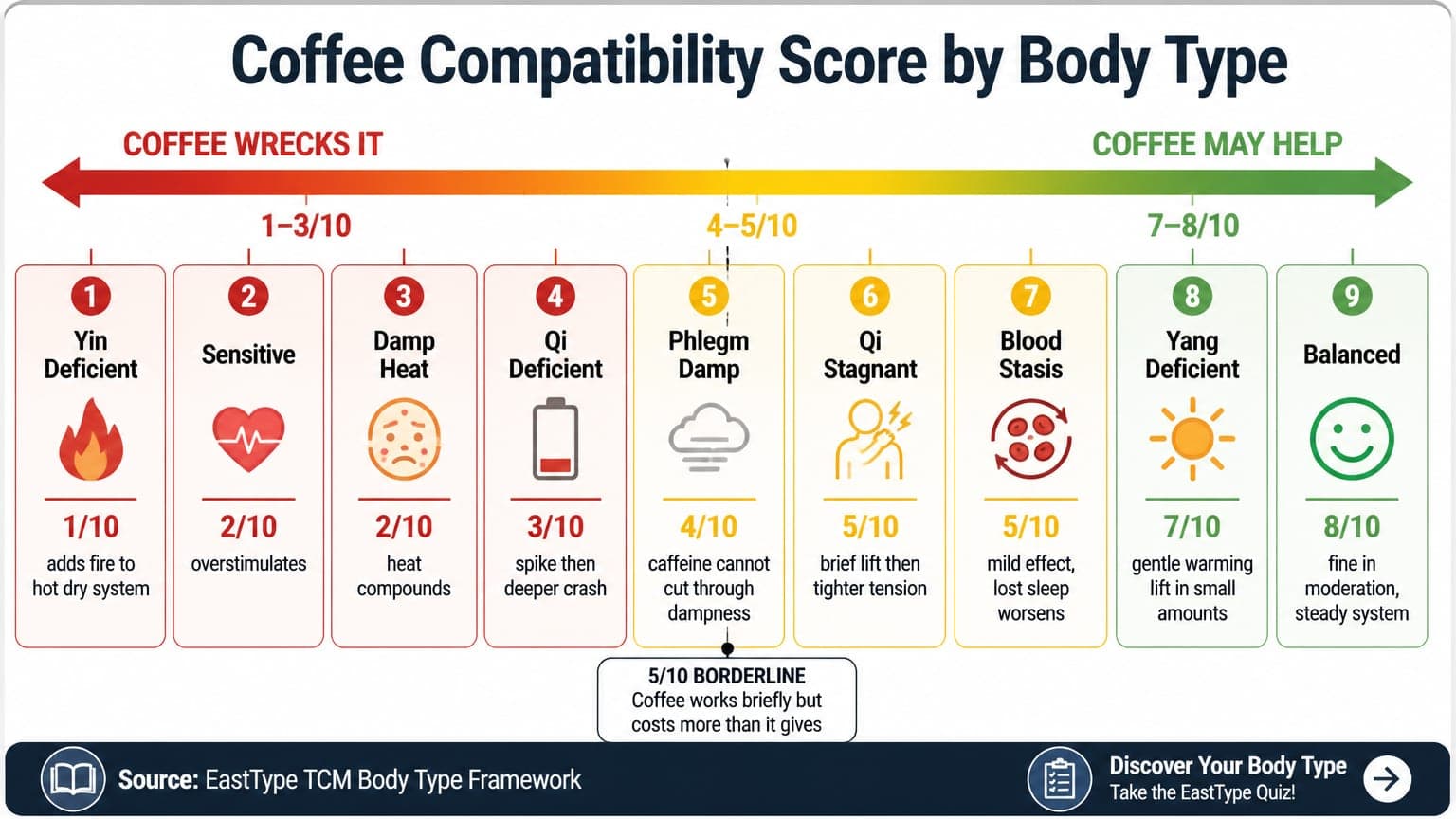
Across the nine body types, coffee compatibility ranges from a near miss to a comfortable fit. Yin Deficient scores lowest, because caffeine pushes an already hot, dry system further out of balance. Yang Deficient and Balanced score highest, since a small amount of warming stimulation lands well on a cold or steady system. Most types sit in the awkward middle, where coffee works briefly but costs more than it gives.
Three Body Types, Three Very Different Reactions
Find out if your body type is coffee-compatible. Take the free 5-minute quiz and learn which of the nine constitutions you fit, so the next cup you reach for actually agrees with your system.
Take the Free Quiz →The Yin Deficient Coffee Trap
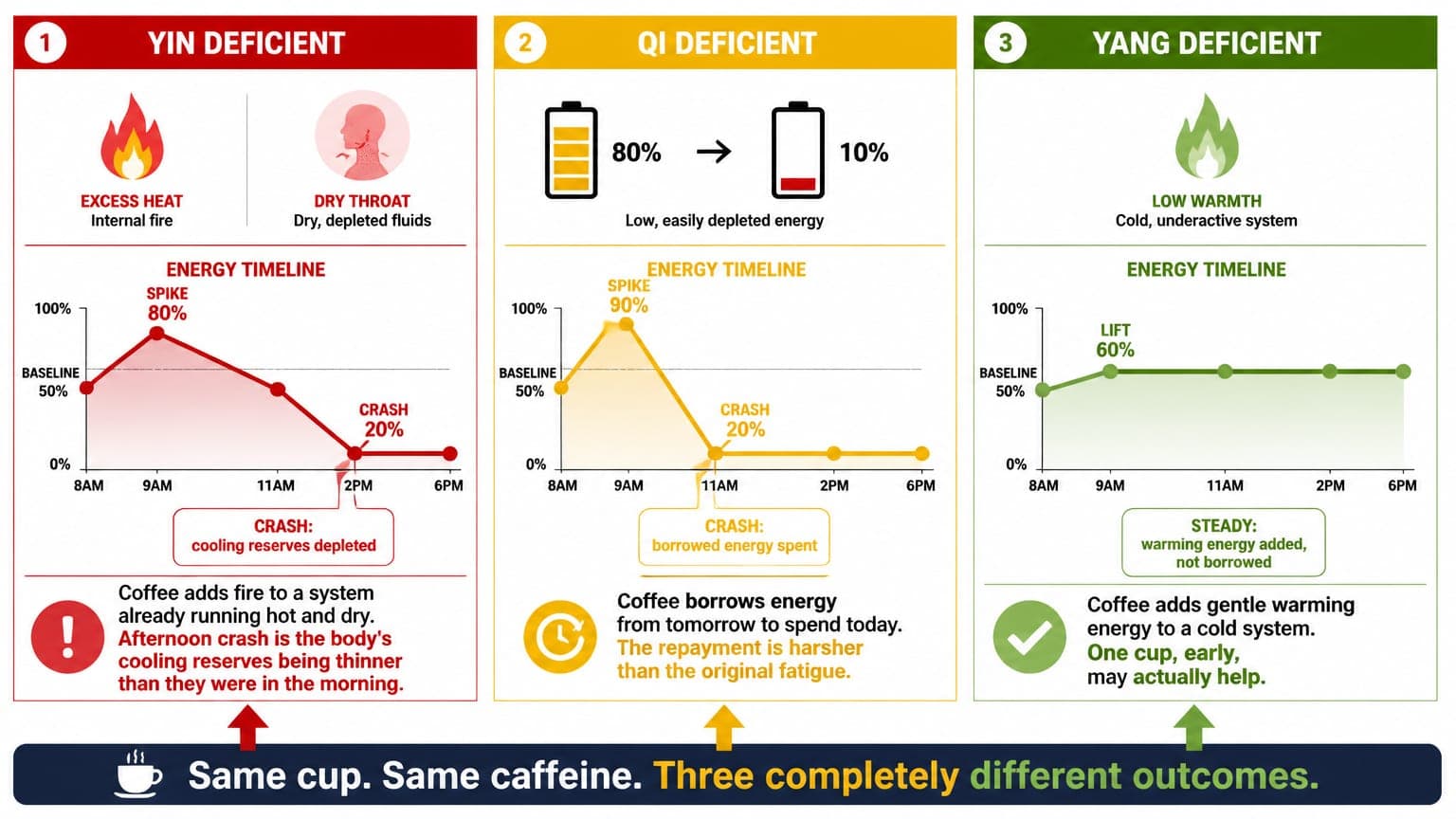
Of all nine body types, Yin Deficient is the one that should be most cautious around coffee, and yet Yin Deficient people are often the ones reaching for the strongest cup. There is a reason for the mismatch. Yin Deficient types tend to feel a low-grade fatigue that sleep does not fully fix, a tiredness that sits under the surface all day. Coffee seems to switch it off for an hour or two, which feels like relief. The problem is what happens underneath that relief. In Chinese medicine, Yin represents the cooling, moistening, resting side of the body's energy. A Yin Deficient person is already running low on that cooling reserve, which is why they tend to run warm, feel dry in the throat and skin, and wake up sweating at night. Coffee is warming, drying, and stimulating. Each cup pushes the system further in the direction it is already leaning too hard. The afternoon crash that follows is not a caffeine wearing off problem. It is the body's cooling reserves being thinner than they were in the morning. Over time, the pattern may deepen. The dry throat gets drier. The night sweats get more frequent. The irritability sharpens. The fatigue that coffee was supposed to fix starts showing up earlier in the day, which leads to another cup, which leads to another crash. If you suspect you are Yin Deficient, the single most useful change you can make may be to stop reaching for coffee as the answer to your tiredness.
The Qi Deficient Rollercoaster
Qi Deficient types have a different problem with coffee, and it is arguably more confusing because the damage is delayed. A Qi Deficient person runs low on the basic energy that powers digestion, breathing, and sustained effort. They feel tired, yes, but it is a soft, deflated tired, not the wired, restless tired of Yin Deficient. When they drink coffee, something happens that looks like a success. For an hour or maybe two, they feel almost normal. They can focus. They can get through the morning. Then the floor drops out. The crash is not just the caffeine wearing off. In TCM terms, coffee borrows energy from tomorrow to spend today. A Qi Deficient system does not have much energy in reserve, so the borrowing is steeper and the repayment is harsher. The afternoon crash hits harder than the morning fatigue ever did, and it tends to come with a foggy head, loose digestion, and a wanting to lie down feeling that no second cup can fix. What makes this a trap is that the morning cup works well enough to feel worth it, and the crash is far enough away that the connection is not obvious. Over weeks and months, the baseline keeps drifting down. The same cup that used to carry you to lunch now barely gets you to 10 AM. The honest answer for Qi Deficient types is that coffee is not giving you energy. It is spending the little you have, and charging interest.
The Yang Deficient Surprise
Here is the twist. Of all nine body types, Yang Deficient is the one that may actually get along with coffee, and that surprises people who assume coffee is universally bad for tired people. Yang Deficient types run cold. Their hands and feet tend to be cool, they prefer warm food and drinks, and they may feel sluggish in a way that warmth and stimulation can genuinely shift. Coffee is warming and moving in nature, which is exactly what a Yang Deficient system is short of. A small cup in the morning, especially in winter, can offer a gentle lift that does not come with the crash that Qi Deficient types experience, because there is actual warming energy being added rather than borrowed. The key word is small. A Yang Deficient person who drinks three or four cups a day is no longer helping. They are overstimulating a cold system and creating the same exhaustion loop as everyone else. One cup, early, before food, is the pattern that tends to work. Beyond that, warming teas like ginger or cinnamon may do the same job more gently.
5 Morning Drinks That May Support Your Body Type Better Than Coffee
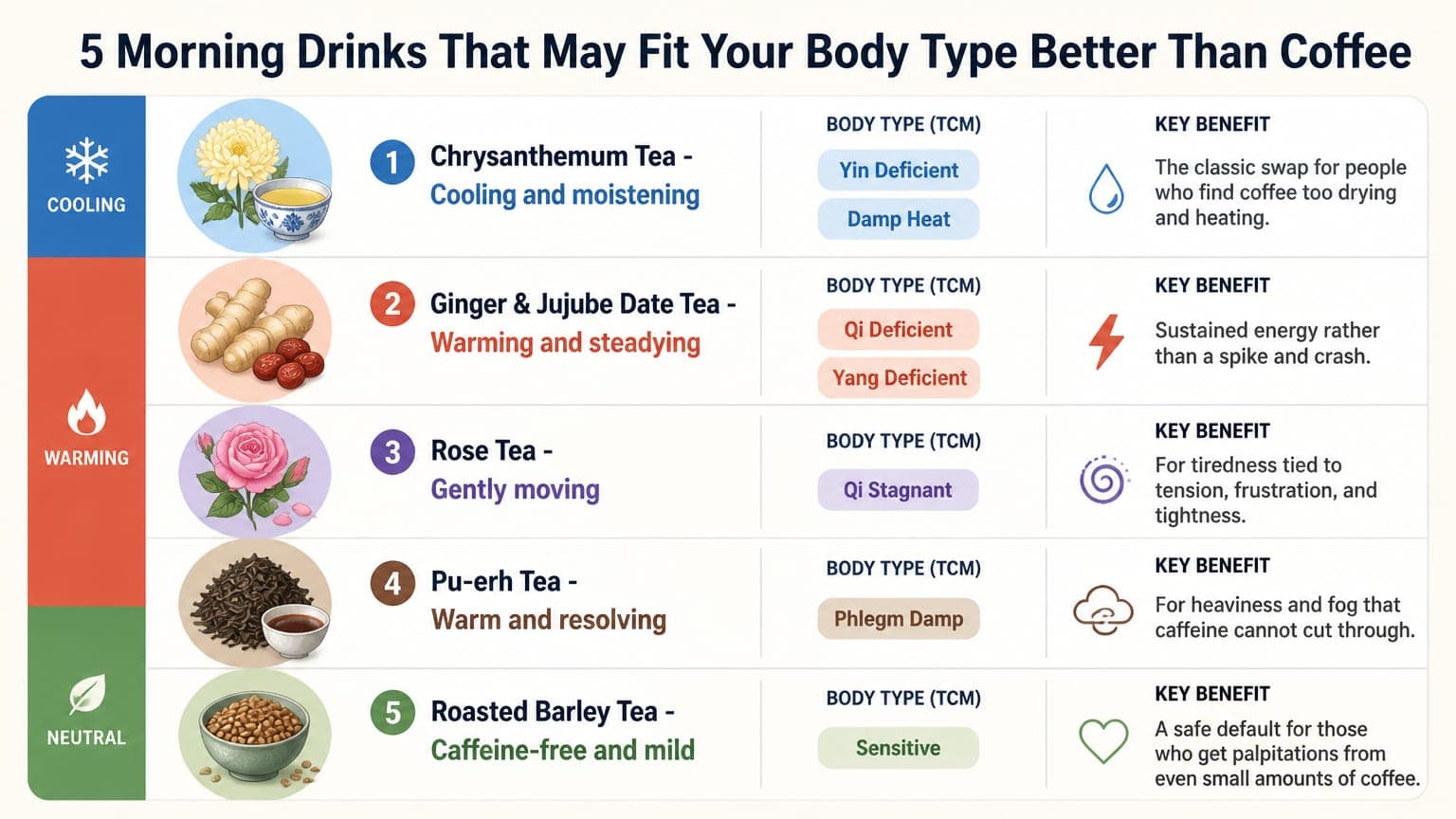
- •Chrysanthemum tea Cooling and gently moistening, this is the classic morning swap for Yin Deficient and Damp Heat types who find coffee too drying and heating.
- •Ginger and jujube date tea Warming and steadying, a strong option for Qi Deficient and Yang Deficient types who need sustained energy rather than a spike.
- •Rose tea Gently moving, this may suit Qi Stagnant types whose tiredness is tied up with tension, frustration, and tightness rather than true deficiency.
- •Pu-erh tea Warm and resolving, a traditional choice for Phlegm Damp types whose heaviness and fog respond better to warmth than to caffeine.
- •Roasted barley tea Caffeine-free, mild, and easy on the digestion, a safe default for Sensitive types who get palpitations from even small amounts of coffee.
5 Coffee Alternatives by Body Type
How to Transition Off Coffee Without the Crash
Quitting coffee badly is worse than not quitting at all. A cold turkey approach tends to produce a three-day headache, a week of fog, and a relapse that convinces you coffee is essential. The body type aware approach below is slower, gentler, and far more likely to stick.
- 1
Halve your cup, do not quit cold turkey
Going from three cups to zero overnight is the fastest way to a three-day headache. Start by cutting each cup in half, or alternating one coffee with one non-caffeinated drink through the morning. The goal is to step down over one to two weeks rather than shock the system.
- 2
Match the swap to your body type
If you run warm or dry, lean toward chrysanthemum or mint tea. If you run cold or tired, use ginger, jujube date, or cinnamon tea. A swap that fits your constitution will satisfy you in a way that a random herbal tea will not.
- 3
Keep the ritual, change the contents
Much of what coffee does for you is the ritual, the warm mug, the smell, the ten quiet minutes. Keep all of it. Only the liquid inside changes. This sounds trivial, and it is the step people most often skip.
- 4
Move caffeine earlier in the day
If you are stepping down rather than quitting, push your last cup earlier by an hour each day until it lands before 11 AM. Caffeine has a long half-life, and afternoon coffee is often what wrecks the sleep that would have fixed the tiredness in the first place.
- 5
Address the tiredness underneath
Most people drink coffee because they are tired, and most tiredness has a cause that coffee cannot reach. Late nights, skipped breakfast, screen time before bed, and a body type that is out of balance all show up as fatigue. Work on those, and the craving for coffee tends to fade on its own.
- 6
Expect a dip, and ride it out
Around day three or four, you will feel worse before you feel better. This is normal. It is the system recalibrating to producing its own energy again. Stay with it. By the end of week two, most people report steadier energy through the afternoon than they ever had on coffee.
Coffee Compatibility at a Glance
Related Articles
Frequently Asked Questions
Is coffee bad for everyone in Chinese medicine?+
Why does coffee make some people crash and others feel fine?+
Which body type should avoid coffee completely?+
Can Yang Deficient people drink coffee every day?+
What is the best coffee alternative for tiredness?+
Discover Your Eastern Type
Take our free 5-minute assessment to explore which body type best matches your current wellness patterns.
Take the Free Quiz→This article is for informational and educational purposes only and is not medical advice. Always consult a qualified healthcare professional for medical concerns.